Section 271(1)(c) Penalty Cannot be Levied Where Disallowance Involves Debatable Issue: ITAT:
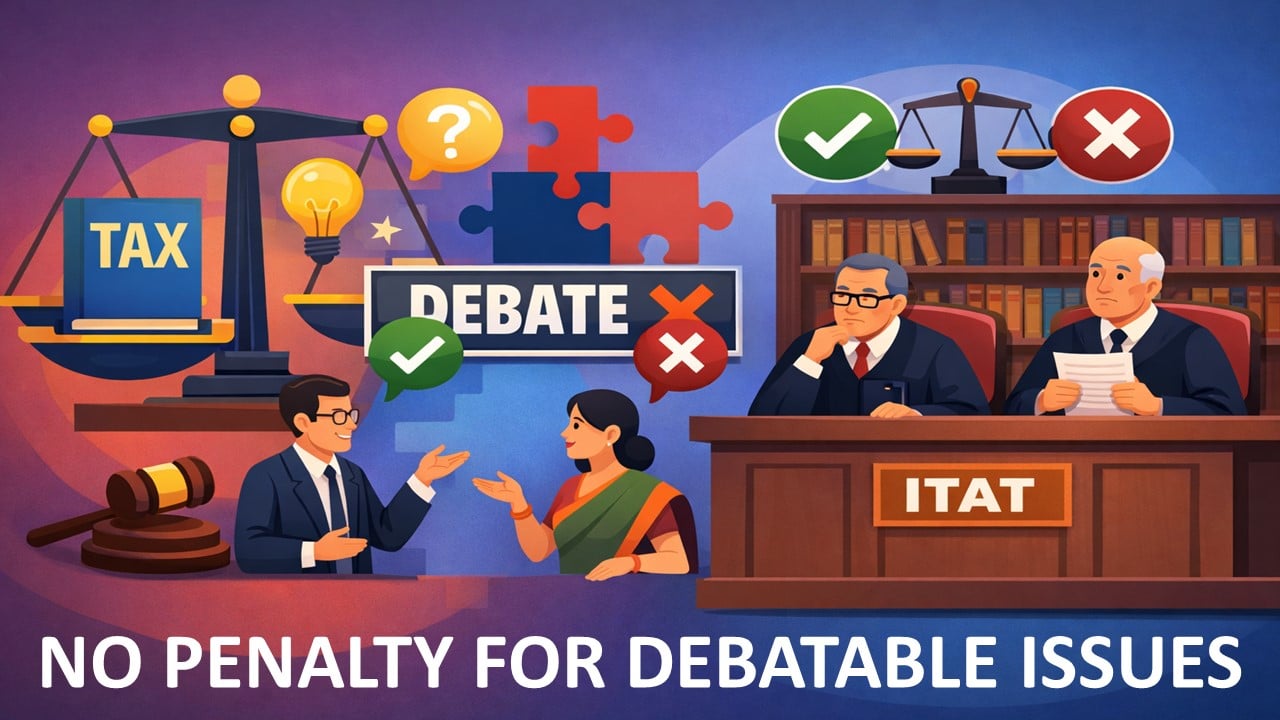
The ITAT said that whether an expense is revenue or capital is a debatable issue, and the penalty under Section 271(1)(c) cannot be levied if the dispute involves debatable legal interpretations.
ITAT Deletes Penalty Under Section 271(1)(c)
 Nidhi
Nidhi Feb 13, 2026
Section 271(1)(c) Penalty Cannot be Levied Where Issue is Debatable: ITAT
The Income Tax Appellate Tribunal (ITAT), Delhi, deleted the penalty under section 271(1)(c) of the Income Tax Act, holding that such a penalty cannot be imposed when the issue is debatable.
The assessee, Cimmco Ltd., filed a nil income tax return (ITR). The assessing officer reopened the case under section 147 of the Income Tax Act and disallowed Rs 1,04,81,261 claimed as a write-off capital expenditure in the profit and loss account. This included expenses of Rs 72,06,320 towards the export benefits as non-recoverable and Rs 32,72,941 towards the security deposit.
Additionally, the AO also imposed a penalty towards the disallowance under section 271(1)(c) of the Income Tax Act, alleging that the assessee had filed inaccurate particulars.
The CIT(A) also upheld the penalty, observing that the company did not explain the inaccurate furnishing of particulars of income, and the company failed to prove that there was no fraudulent intention.
However, the ITAT said that whether an expense is revenue or capital is a debatable issue, and the penalty under Section 271(1)(c) cannot be levied if the dispute involves debatable legal interpretations.
The Tribunal also explained the difference between a wrong claim and a false claim, stating that an assessee may be punished by the tax department for a false claim. The Tribunal concluded that the AO has failed to prove that the assessee had made a false claim or that the case involves concealment of income or filing inaccurate particulars.
Therefore, the Tribunal directed the AO to delete the penalty levied on the assessee under Section 271(1)(c) of the Income Tax Act.
About Author


Nidhi
Content Writer
Nidhi is a skilled content writer specializing in personal finance. She creates clear, engaging articles on mutual funds, investments, insurance, and wealth-building strategies. With a passion for simplifying complex financial topics, Nidhi helps readers make informed money decisions with confidence. She can be reached at [email protected]
Nidhi is a skilled content writer specializing in personal finance. She creates clear, engaging articles on mutual funds, investments, insurance, and wealth-building strategies. With a passion for simplifying complex financial topics, Nidhi helps readers make informed money decisions with confidence. She can be reached at [email protected]
 Studycafe
 New Delhi, Delhi, India
 1832
1832My Recent Articles
- Karnataka High Court Gives Another Chance in GST Matter Due to Lack of Hearing
- Delay Should Be Condoned if Explanation is Unrefuted: ITAT
- Non-Service of Income Tax Notice, Ill health of taxpayer, ITAT condones Appeal filing delay
- Books of Accounts Cannot be Rejected Without Any Specific Defect: ITAT Kolkata
- Karnataka High Court Sends ITC Matter Back to GST Authorities for Reconsideration
Up Next
Loading suggestions…


Recent Posts

All Posts

Tags
Recent Posts
All Posts