WBAAR Rules on GST Applicability on Arbitration Awards under Pre-GST Contracts:
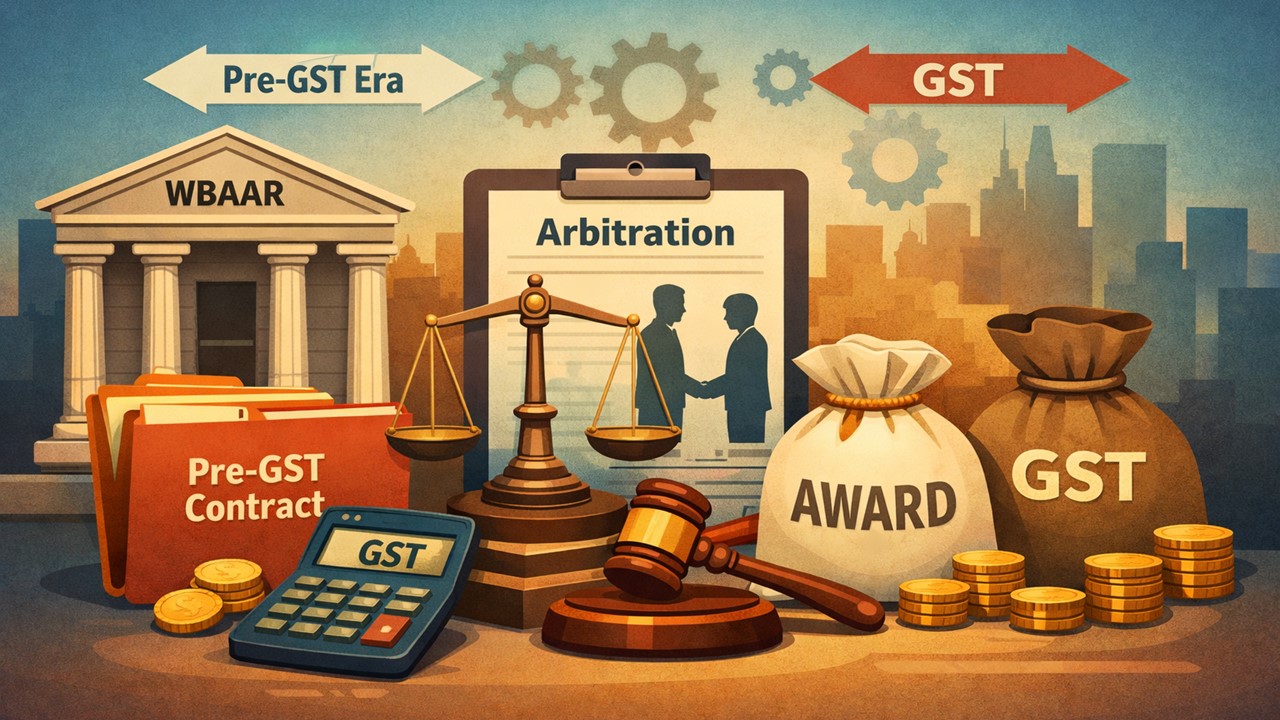
As per WBAAR, GST is not applicable to the arbitration cost awarded to the applicant, but 18% GST must be paid on the fees paid to arbitrators separately.
Taxability of Arbitration Claims under GST
 Nidhi
Nidhi Feb 20, 2026
WBAAR Rules on GST Applicability on Arbitration Awards under Pre-GST Contracts
The applicant, Karam Chand Thapar & Bros (Coal Sales) Limited, signed three contracts with THDC India Ltd in 1996 related to the execution of construction work of hydropower plants, which were completed in the year 2007-08. The assessee received the final payment in 2011. During the project, the applicant had to spend extra money. Because of these extra costs, disputes arose between the applicant and THDC, and an Arbitral Tribunal was set up to decide the disputes related to all three contracts.
In 2023, the tribunal ruled in favor of the applicant, and it allowed private quarry costs, costs incurred on excavation method changes, costs involved in the use of higher grades, etc., incurred by the applicant. Finally, in October 2024, the applicant received payment according to the Settlement Agreement.
The applicant made an application under section 97(1) of the GST Act before the West Bengal Authority for Advance Ruling (AAR) to get an advance ruling on the following questions:
i) That whether claims allowed by the Arbitral Tribunal vide the Arbitration Awards be termed as supply or not?
ii) That whether claims allowed by the Arbitration Tribunal vide the Arbitration Awards be termed as liquidated damages or not?
iii) That whether GST would be applicable, on the claims allowed vide Arbitration Awards and payment received pursuant to Conciliation Proceedings resulting into the Settlement Agreement, both during the GST regime?
iv) That whether GST would be applicable for the cost of arbitration allowed vide Arbitration Award and received vide the Settlement Agreement, both during the GST regime?
v) If the answer to the above (iii), (iv) and /or (v) are in affirmative, then under what SAC and GST rate is the said liability to be discharged by the applicant and at what time?
vi) That for (vi) above, whether debit note / supplementary invoices or tax invoice need to be issued by the applicant to the contractor in order to recover and discharge the tax liability?
The WBAAR clarified which claims can be considered as supply under GST. As per the authority, "The claims allowed for extra expenditure due to change in the methodology for excavation of control gate shafts, claims allowed due to payment of price adjustment on extra items, claims allowed for deduction or deletion from final bill, for extra expenditure incurred for excavation of compressors and receiver's room at the end wall of machine hall, for payment of cost of materials for work of pre-stressed anchor in the blind holes, for extra expenditure for backfilling behind the walls of the TRT outlet, and claims allowed as refund of rebate wrongfully recovered or deducted and rebate wrongfully deducted from price adjustment are to be considered as supply." GST is applicable to those amounts.
However, the claims related to the expenses incurred in buying boulders, aggregates and sand from private agencies; for operating private quarries; for the cost difference for the actual use of a higher grade of cement; and the claims allowed as reimbursement of expenditure for the shifting of infrastructure facilities are not treated as supply. Therefore, GST is not applicable to these amounts.
The authority explained that the claims allowed by the arbitration tribunal can be treated as liquidated damage except the claims related to purchasing boulders, aggregates and sand from private agencies; claims allowed for operating private quarries; claims allowed for cost difference for actual use of higher-grade cement; and claims allowed as reimbursement of expenditure for shifting of infrastructure facility do not fall in any of the provisions of the contract.
As per WBAAR, GST is not applicable to the arbitration cost awarded to the applicant, but 18% GST (9% CGST + 9% SGST) must be paid on the fees paid to arbitrators separately.
The applicable SAC code is 995422 for general construction services as per Entry No. 3(xii) of Notification No. 11/2017 – Central Tax (Rate) Dated 28.06.2017, as amended. This attracts GST at 9% CGST + 9% SGST.
Also, in cases where the claim is treated as a supply, the applicant must issue a supplementary invoice or debit note to discharge the GST liability.
The authority also ruled that, as per section 142(2)(a), if the price of goods or services is increased after GST implementation (i.e., after 01.07.2017), and this increase is based on a contract made before GST came into effect, then the supplier must issue a supplementary invoice or debit note. This invoice must be treated as a supply under GST, and GST will be payable on the increased amount.
About Author


Nidhi
Content Writer
Nidhi is a skilled content writer specializing in personal finance. She creates clear, engaging articles on mutual funds, investments, insurance, and wealth-building strategies. With a passion for simplifying complex financial topics, Nidhi helps readers make informed money decisions with confidence. She can be reached at [email protected]
Nidhi is a skilled content writer specializing in personal finance. She creates clear, engaging articles on mutual funds, investments, insurance, and wealth-building strategies. With a passion for simplifying complex financial topics, Nidhi helps readers make informed money decisions with confidence. She can be reached at [email protected]
 Studycafe
 New Delhi, Delhi, India
 1832
1832My Recent Articles
- Karnataka High Court Gives Another Chance in GST Matter Due to Lack of Hearing
- Delay Should Be Condoned if Explanation is Unrefuted: ITAT
- Non-Service of Income Tax Notice, Ill health of taxpayer, ITAT condones Appeal filing delay
- Books of Accounts Cannot be Rejected Without Any Specific Defect: ITAT Kolkata
- Karnataka High Court Sends ITC Matter Back to GST Authorities for Reconsideration
Up Next
Loading suggestions…


Recent Posts

All Posts

Recent Posts
All Posts