57th GST Council Meeting: Major Reforms Proposed to Simplify Compliance, Speed Up Refunds and Boost Ease of Doing Business:
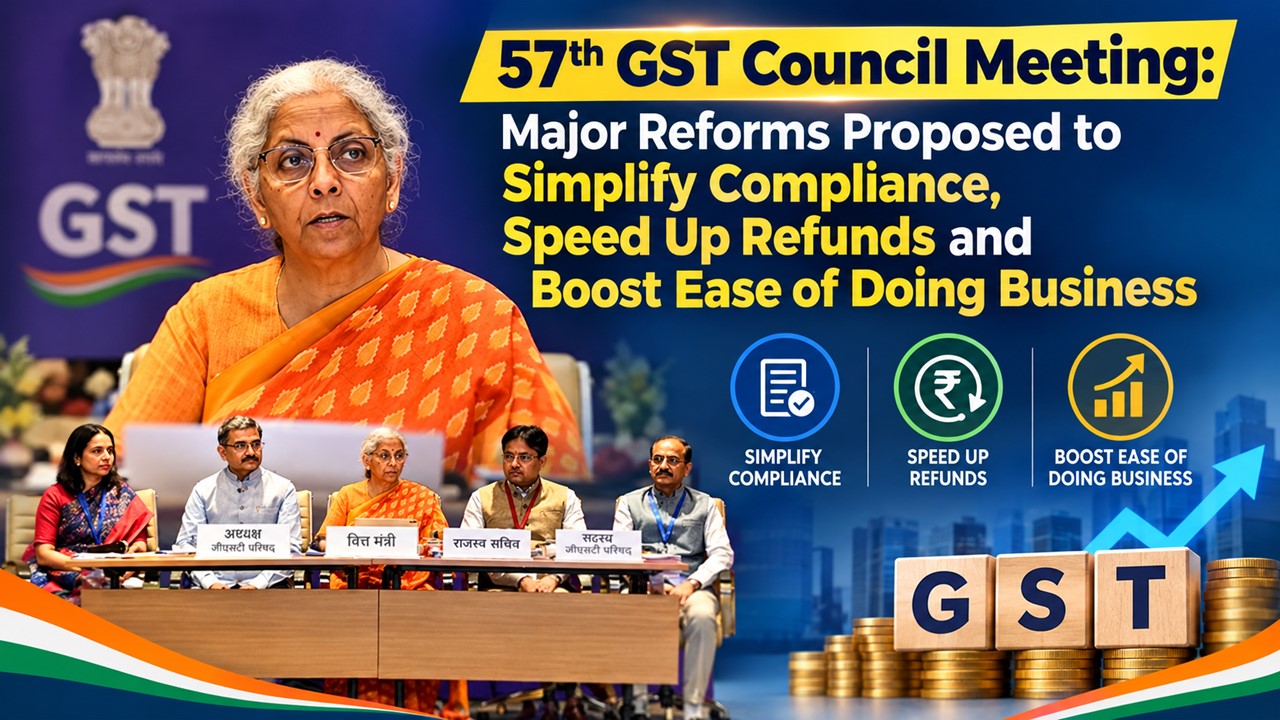
An overview of the key recommendations from the 57th GST Council Meeting to simplify compliance, streamline procedures, expedite refunds, and improve ease of doing business.
GST Compliance: New Reforms and Simplifications
 Vanshika verma
 Oct 9, 2026
Table of Contents

The GST Council, at its 57th meeting held in New Delhi on October 8, 2026, recommended a series of reforms to simplify GST compliance, reduce the burden on businesses and improve the ease of doing business.
The participants included Cheif Ministers of Delhi, Goa, Haryana, Jammu & Kashmir, Karnataka, Kerala, Maharashtra, and Meghalaya; Deputy Chief Ministers of Manipur and Telangana; the Finance Ministers and senior members of states/union territories with Legislative Assesmbly, Secretary, Department of Revenue; Chairman and Members of Central Board of Indirect Taxes and Customs and senor officials of the Ministry of Finance.

Next-Gen reforms made as per recommendations of the GST Council in its 56th meeting last year had focussed on rate rationalisation and reduction of rates. In the 57th meeting today, GST Council made recommendations relating to process reforms primarily covering registration, returns, refund and adjudication; clarifications regarding applicability of GST on supply of certain goods and services; and other measures for trade facilitation and streamlining compliances in GST. FAQs are being issued for clarification of doubts. Major recommendations made in the 57th GST Council meeting are as below:
Arrest Provisions Under GST to Be Removed
The Council recommended removing arrest powers under the CGST Act and raising the prosecution threshold from Rs 1 crore to Rs 5 crore. The move aims to promote a trust-based tax system while maintaining safeguards against fraud and tax evasion.
Reduction of General Penalty
The maximum general penalty under GST is proposed to be reduced from Rs 25,000 to Rs 10,000. The Council also suggested a minimum threshold of Rs 10,000 for issuing show-cause notices and steps to cut down unnecessary litigation.

Faster GST Refunds for Business
The Council also recommended the automated processing of eligible GST refunds to help reduce delays and improve business cash flow. Under the proposed first phase, 90% of the eligible refund claims pertaining to zero-rated supplies and inverted duty structure can be provisionally sanctioned through risk-based system.
Easy GST Registration Process for Small Sellers
A simplified registration process may be available to small sellers on e-commerce platforms. Eligible businesses can sell in other states without having to establish physical place of business in each state subject to prescribed conditions.
Expanded Input Tax Credit Benefits
The Council suggested to ease the restrictions on input tax credit for a number of expenses like outdoor catering, health and life insurance, telecommunication towers and certain pipelines. It also proposed refunds of accumulated credit on certain capital goods and input services, subject to conditions.
Simplified GST Returns and Compliance
The proposed changes aim to reduce mismatches between GST returns, tax liabilities and input tax credit claims. The revised mechanism is recommended to take effect from the April 2027 return period, subject to the prescribed process and consultation.
Relief for Small Taxpayers
The Council approved in principle an optional Annual Return Quarterly Payment (ARQP) scheme for eligible businesses with turnover of up to Rs 5 crore that exclusively supply goods or services to unregistered customers. It also recommended waiving late fees for eligible small taxpayers who file delayed returns by the end of the month in which they were due.
Easier Movement of Goods Across States
The Council recommended that goods-carrying vehicles generally be intercepted only on specific intelligence and with authorisation from an officer of at least Joint Commissioner rank. The proposed changes aim to reduce unnecessary interruptions during transportation.
Exports of Services Get a Boost
Proposed amendments seek to simplify the GST treatment for certain cross-border services and enable refunds for Indian service providers dealing with foreign offices or branches. The Council also recommended clarification of the payments received for exports.
GST on Goods & Services Changes
The Council made recommendations on a number of clarifications and amendments including nil GST rate on psyllium seeds, measures on transactions involving waste and scrap, and the option of 5% GST on certain passenger transport and vehicle rental services using electric vehicles, subject to conditions.
It also recommended exemptions for certain services, including storage of seeds meant for sowing and curing of coffee.
Focus on Ease of Doing Business
The recommendations cover registration, refunds, dispute resolution, input tax credit and transportation. The proposed reforms are intended to reduce paperwork, improve transparency and provide greater certainty to taxpayers.
For complete information, refer to the following press release:-
About Author


Vanshika verma
Content Writer
 Studycafe
 Delhi, Delhi, India
 2050
2050My Recent Articles
- PM Modi Calls for Global System to Fight Cyber Fraud and Deepfakes as India Pushes for Greater International Cooperation on Digital Security
- Income Tax Officials Conduct Survey at Maharajganj Municipal Cooperative Bank, Examine Large Accounts, Loans and Suspicious Transactions
- GST Council Meeting Today: Centre May Consider Changes to Arrest Powers, ITC Protection, Refund Processing and GST Registration Rules
- Max Estates Receives Rs 2.59 Crore GST Show Cause Notice From UP Tax Department Over FY23 Return and Reconciliation Issues
- CBI Arrests Chandigarh MC Sanitary Inspector for Allegedly Demanding Rs 14 Lakh Bribe to Clear Contractor’s Pending and Future Bills
Loading suggestions…


Recent Posts
All Posts

Recent Posts
All Posts