GST Council Meeting Today: Centre May Consider Changes to Arrest Powers, ITC Protection, Refund Processing and GST Registration Rules:
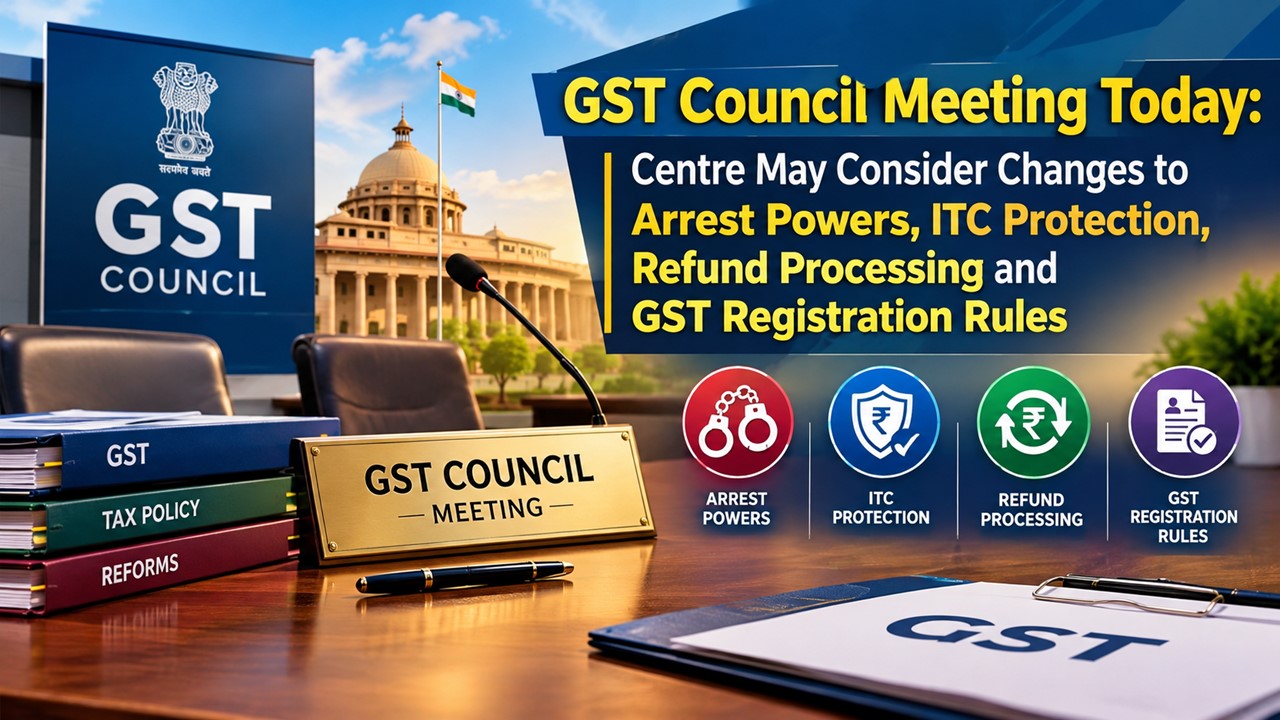
The 57th GST Council meeting may bring key reforms on arrest powers, ITC protection, faster refunds, registration and compliance rules.
GST Council May Ease Arrest, ITC Rules
 Vanshika verma
 Oct 8, 2026
Table of Contents

The GST Council on Thursday began its 57th meeting here during which the government is expected to discuss several changes to make the Goods and Services Tax (GST) system simpler and easier for businesses and taxpayers. Unlike the previous meeting, the focus this time is expected to be less on changing tax rates and more on improving compliance, refunds, input tax credit (ITC) and dispute resolution.
The meeting is being chaired by Union Finance Minister Nirmala Sitharaman and is being held at Bharat Mandapam in New Delhi. The meeting was earlier scheduled for September 12, then moved to October 7 and later rescheduled to October 8. The formal agenda has not been made public.
The meeting comes more than a year after the 56th GST Council meeting in September 2025, when the government announced major changes to GST rates under the GST 2.0 reforms. This time, the Council is expected to focus on making the GST system faster, simpler and more predictable.

Changes in GST Arrest Powers
One of the key issues before the Council is the power of GST officers to arrest taxpayers. A proposal may seek to require court approval before a GST officer can make an arrest. The aim is to ensure that serious cases of tax evasion are treated differently from routine compliance disputes.
The Council may also consider increasing the threshold for starting criminal prosecution from Rs 1 crore to Rs 5 crore. The proposal could also reduce the number of GST-related cases that can result in criminal proceedings.

However, the proposal has faced opposition from some states, including Maharashtra, Gujarat, Uttar Pradesh, Karnataka and Andhra Pradesh. This could make the issue one of the most debated topics at the meeting.
Tax experts believe that giving greater judicial oversight to arrests and keeping routine disputes outside the criminal process could reduce fear among honest taxpayers and also lower litigation.
Protection for Genuine Buyers on Input Tax Credit
Another important issue is input tax credit. At present, businesses can face problems if a supplier fails to pay tax or file returns, even when the buyer has followed the rules.
The Council may consider giving genuine buyers greater protection in such cases. Experts have suggested a legal safeguard that would allow compliant businesses to retain legitimate ITC even if their suppliers default.
This could be important for companies because blocked ITC affects their working capital and can lead to long-running disputes with tax authorities.
Faster GST Refunds
Faster refunds are also expected to be discussed. Exporters and businesses facing inverted tax structures often have large amounts of money stuck in refunds.
The Council may consider making refund processing more automated and time-bound. A maximum processing period of around 17 days is being considered.
Another proposal could change the formula for refunds under the inverted-duty structure to include input services. This could allow businesses to claim a larger portion of their eligible refunds.
Experts said faster refunds could reduce working-capital pressure, particularly for industries such as pharmaceuticals and FMCG.
Easier GST Registration and Return Filing
The Council may also look at simplifying GST registration and return filing. The 56th meeting had already approved a fast-track, three-day registration process for low-risk applicants.
The next step could be to expand and standardise this system. The Council may also consider improving the GST return system so that businesses can make corrections during the month and use data from e-invoices to automatically fill in or correct information.
Such changes could particularly help small businesses and MSMEs by reducing manual work and preventing mistakes that later result in tax notices or disputes.
Biometric Aadhaar Authentication
The Council may also discuss biometric Aadhaar authentication for GST registration. The move is aimed at preventing fake registrations and identity theft while making the registration process easier for genuine businesses.
Experts said the Council could consider the recent Delhi High Court orders on biometric authentication and may look at introducing a uniform system across the country.
Export Status for Certain Domestic Manufacturing Activities
Another proposal could benefit Indian manufacturers working for overseas companies.
The Council may consider treating certain manufacturing activities carried out in India for foreign customers as exports, even when the finished goods do not physically leave India.
This could help Indian contract manufacturers that process materials for overseas companies but deliver the finished products within India according to the customer's instructions.
Experts believe such a move could support sectors such as semiconductors and electronics. Similar benefits could also be considered for activities such as repair, testing, storage and job work.
More ITC Benefits for Businesses
The Council may also consider expanding the situations in which businesses can claim input tax credit.
Proposals could cover areas such as employee group insurance, outdoor catering, free samples and goods that are destroyed after expiry.
For industries such as pharmaceuticals and FMCG, allowing ITC in more cases could reduce the amount of money blocked in the tax system and improve cash flow.
Penalties and Show-Cause Notices
The wider objective of the proposed reforms is to create a clear difference between genuine mistakes and deliberate tax evasion.
The Council may consider reducing or rationalising penalties in cases where there is no fraud. It could also look at standardising the process for issuing show-cause notices.
Tax experts believe simpler procedures and a more reasonable penalty system could reduce the number of disputes and lower compliance costs for businesses.
GST Rates Not the Main Focus
Unlike the 56th GST Council meeting, the October meeting is not expected to bring another major round of GST rate changes.
Instead, the focus is likely to be on the basic functioning of the GST system, including registration, return filing, input tax credit, refunds, enforcement and dispute resolution.
For businesses, the next phase of GST 2.0 is therefore expected to be less about cutting tax rates and more about reducing the difficulties involved in complying with the law.
The main expectation from the meeting is that businesses should be able to complete GST procedures more easily, receive refunds faster and avoid unnecessary disputes. The real test, however, will be how quickly and consistently these proposals are converted into rules and implemented on the ground.
About Author


Vanshika verma
Content Writer
 Studycafe
 Delhi, Delhi, India
 2047
2047My Recent Articles
- Max Estates Receives Rs 2.59 Crore GST Show Cause Notice From UP Tax Department Over FY23 Return and Reconciliation Issues
- CBI Arrests Chandigarh MC Sanitary Inspector for Allegedly Demanding Rs 14 Lakh Bribe to Clear Contractor’s Pending and Future Bills
- MRF Gets Major Tax Relief as Kerala Authority Slashes Sales Tax Demand from Rs 91.53 Crore to Rs 36.19 Crore
- Income Tax Department Conducts Searches at Prime Focus Offices Over Reported Foreign Remittances Ahead of Much-Awaited Ramayana Release
- ED Conducts Searches at 20 Locations Across Kerala in Three Cooperative Society Fraud Cases Involving Alleged Fake Loans and Illegal Property Transfers
Loading suggestions…


Recent Posts


All Posts

Recent Posts
All Posts