The Income Tax Act sets specific limits and rules for cash deposits, withdrawals, and loans to prevent tax evasion, with penalties for unreported or unverified transactions.
Saloni Kumari | May 1, 2025 |
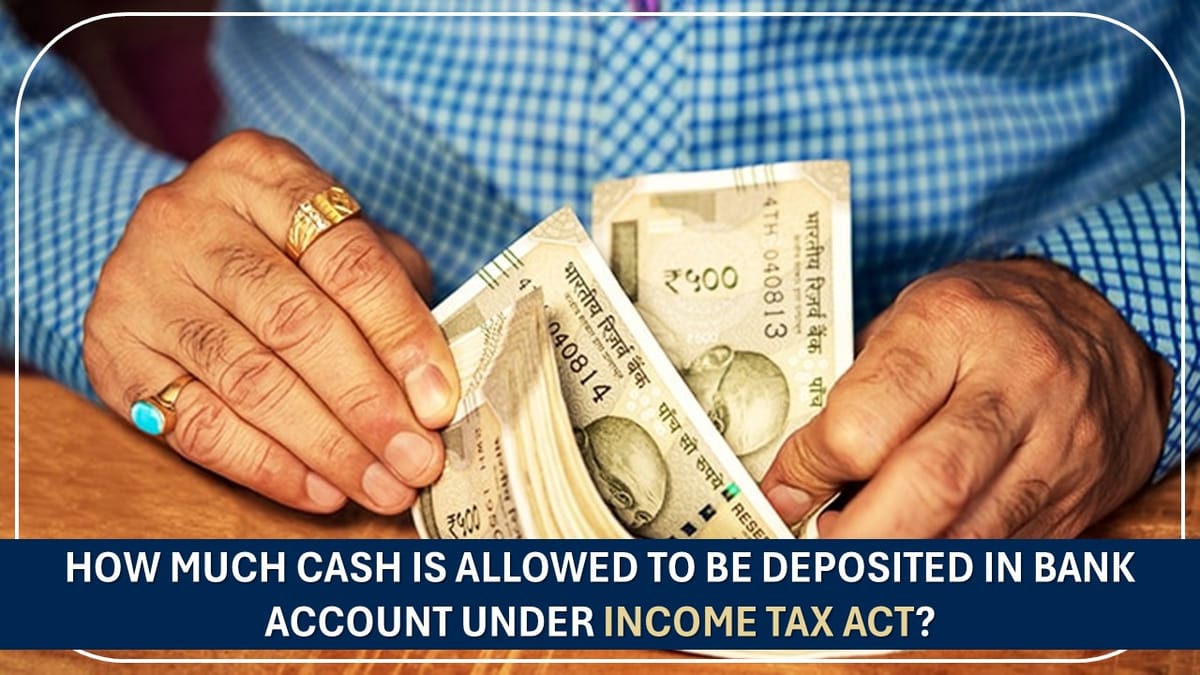

Customers are only allowed to deposit cash up to a certain limit in their savings accounts under the Income Tax Act. Till this limit, a person is permitted to deposit money in his/her account in a specified time period. This rule has been made to keep an eye on cash transactions made by customers, to prevent illegal activities such as money laundering, tax evasion and others. If a customer makes deposits upto Rs. 10 or above in a financial year, then he/she is to inform the income tax department. This limit is till Rs. 50 lakh for current account customers.
However, tax is not imposed on these directly immediately. Banks and financial institutions keep a check on customers crossing their limits in (Rs 10 lakh) savings and (Rs 50 lakh) current account deposits, and then inform the income tax department.

Section 194N of the Income Tax Act includes rules related to the Tax Deducted at Source (TDS) on cash withdrawals. 2 per cent TDS is deducted if an individual withdraws more than 1 crore cash in a financial year. Individuals who have filed Income Tax Return (ITR) for the previous three years, 2 per cent and 5 per cent TDS is reduced on withdrawals above Rs 20 lakh and Rs 1 crore, respectively. This TDS is not counted as income. However, it can be used as a credit amount at the time of filing the ITR.
In line with section 269ST, if 2 lakh or more is accepted by an individual in a financial year or through a single transaction, then a penalty can be imposed on him/her. But this penalty is not applicable to the cash withdrawal made with a bank. But still, if the individual exceeds the limit, TDS is deducted.
Sections 269SS and 269T, are associated with the cash loans. If a cash loan of more than Rs 20,000 is repaid by an individual, then he/she may be asked to pay a penalty equal to the amount. One should be aware of the income tax rules to understand them. If you run a business and the money you deposit matches the turnover you reported in your income tax return, especially under sections 44AD or 44ADA, then there’s no problem. But if the amount you deposit doesn’t match what you’ve reported, the Income Tax Department may investigate.
If an individual is unable to show the source of his/her income, then an income tax notice can be issued to him/her as per section 68. In that case, 60% tax, 25% surcharge and 4% cess can be imposed on unverified income.
If you deposit cash upto Rs. 10 lakh in a savings account or upto Rs. 50 lakh in your current account, then you must report to the IT department. The money you deposit isn’t taxed right away, but if you can’t clearly show where it came from, the Income Tax Department may investigate. If you don’t follow the rules, you could face a fine or have to pay extra tax.

In case of any Doubt regarding Membership you can mail us at [email protected]
Join Studycafe's WhatsApp Group or Telegram Channel for Latest Updates on Government Job, Sarkari Naukri, Private Jobs, Income Tax, GST, Companies Act, Judgements and CA, CS, ICWA, and MUCH MORE!"