Understanding the cash deposit limit is important to avoid penalties and notices from the Income Tax Department.
Nidhi | Jun 25, 2025 |
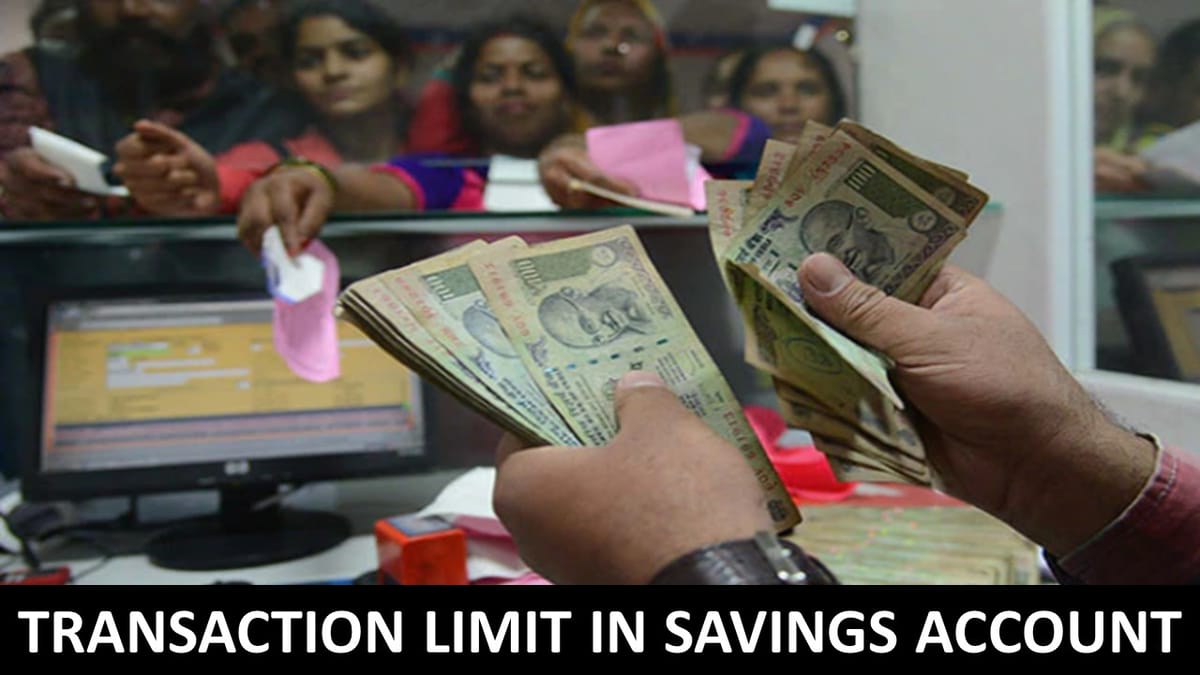

How Much Cash Can You Deposit in a Savings Account Without Getting Tax Notice?
Income Tax authorities issue a notice when they observe that the taxpayer is doing large-value transactions, including depositing or withdrawing large cash amounts. But have you ever wondered how much cash you can deposit or withdraw from your savings account each year without attracting the attention of income tax authorities? Understanding the cash deposit limit is important to avoid penalties and notices from the Income Tax Department.

Experts say that, according to income tax rules, the total cash you put into or take out of your savings account during a financial year must remain below Rs 10 lakh to avoid getting noticed by the income tax department. In case you deposit cash above Rs 10 lakh in all your savings accounts within a financial year, then you should disclose this to the income tax department.
Also, you should not receive Rs 2 lakh or more in cash from the same person in a single day, whether it is one payment or several payments related to the same event or occasion.

People often ask about how much cash they can deposit in their bank accounts without facing problems or extra paperwork. While there is no fixed daily cash deposit limit set by the Reserve Bank of India (RBI) for everyone, there are certain limits. If you cross these limits, you will be required to share more information with the bank and tax authorities.
Up to Rs 50,000: You can deposit cash up to Rs 50,000 in a single transaction without providing your PAN details, as long as your bank account is already linked to your PAN.
Above Rs 50,000: If you deposit more than Rs 50,000 in cash at once, you must provide your PAN card details. If you don’t have a PAN, you will need to fill out Form 60 or 61.
Large Daily Deposits: As per some sources, the cash deposit limit is Rs 1 lakh and up to Rs 2.5 lakh on special occasions. But generally, if you deposit more than Rs 2.5 lakh in a day (Rs 5 lakh for senior citizens), it will be treated as a large deposit. This may lead to the Income Tax Department asking questions about where the money came from.
Each financial year, you can deposit up to Rs 10 lakh in cash across all your savings accounts without any issues. If your total cash deposits go over this limit, banks are required to inform the Income Tax Department (as per the rules under the Income Tax Act, 1962).
If you deposit more than Rs 10 lakh in cash during the year, you might get a notice from the tax department. This does not mean you will be taxed, but you will have to explain where the money came from. It could be from your salary, business income, a loan, a gift, or even inheritance.
If you are unable to give a proper explanation or proof, the income tax authorities might treat that money as unexplained income, and you could face taxes or penalties.
Unlike cash deposits, there is no strict daily limit for cash withdrawals from savings accounts set by the government for tax reporting. However, banks and tax laws do have some rules you should know.
If you are transferring money digitally, the limits are much higher compared to cash transactions. These limits vary depending on the method you use and the bank’s rules. Here’s a simple breakdown:
NEFT (National Electronic Funds Transfer): Many banks allow individual transactions up to Rs 2 lakh. However, depending on your bank policies, your daily transfer limit can go up to Rs 5 lakh, Rs 10 lakh, or even Rs 50 lakh for online NEFT transactions per day.
RTGS (Real Time Gross Settlement): RTGS is for large-value transactions and has a minimum limit of Rs 2 lakh per transaction. Depending on your bank, the per-transaction or daily limit can go up to Rs 5 lakh, Rs 10 lakh, or even higher. RTGS is fast and reliable, especially for business- or property-related payments.
IMPS (Immediate Payment Service): IMPS is best for making small- to medium-sized transfers and is available 24 hours, even on holidays.
UPI (Unified Payments Interface): UPI is one of the most convenient and secure ways to transfer money using a mobile app.

In case of any Doubt regarding Membership you can mail us at [email protected]
Join Studycafe's WhatsApp Group or Telegram Channel for Latest Updates on Government Job, Sarkari Naukri, Private Jobs, Income Tax, GST, Companies Act, Judgements and CA, CS, ICWA, and MUCH MORE!"