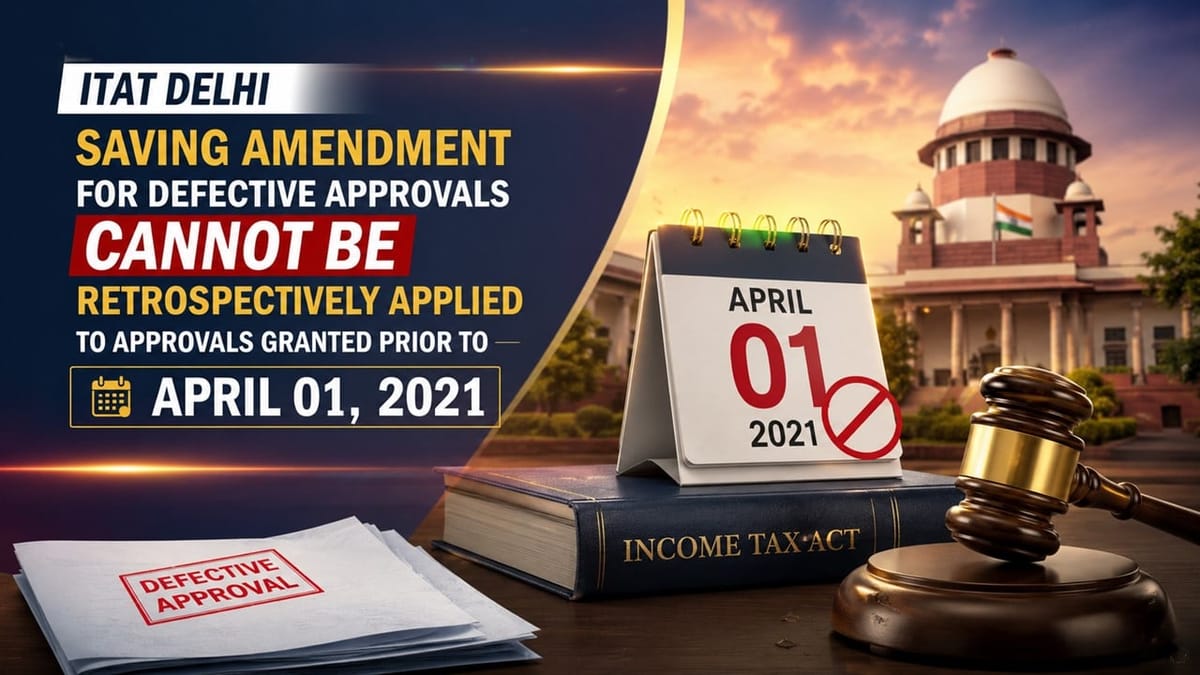
The ITAT Delhi says that the saving amendment for defective approvals cannot be retrospectively applied to the approvals granted prior to April 01, 2021.
Saloni Kumari | May 25, 2026 |

ITAT Invalidates Section 153D Approval As Given Without Application of Mind
The Delhi Bench of the Income Tax Appellate Tribunal (ITAT) in the case of Aseem Kumar Gupta v. ACIT quashed assessment orders for the assessment years 2004-05 to 2010-11 as the assessee challenged the assessments framed under Sections 153A read with 143(3) of the Income Tax Act on the ground that the mandatory approval under Section 153D had been granted through a common approval letter covering multiple assessment years and several assessees together. The assessee argued that the CIT(A) granted approval on the very same day the assessing officer sought it, i.e., on 30.12.2011, without independently examining the draft assessment orders. It was further contended that such approval was merely a rubber-stamp exercise and therefore invalid in the eyes of the law.

The tax authorities contended that Section 292BC, added by the amendment with effect from 01.04.2021, provides that an assessment order can not be held as invalid only due to a defective or faulty approval and pleaded that the assessment should not be invalidated on the basis of a technicality of approval.
Thereafter, the case was taken to the ITAT Delhi Bench. It noted that the legislative amendment protecting assessments from defective approvals specifically carries a prospective rider and is applicable strictly to approvals granted on or after April 1, 2021. Since the Adl. CIT had granted approval in the assessee’s case on a date prior to the date of application of amendment, the Tribunal observed that the amendment could not be applied in a retrospective manner to the flawed approval to provide the benefit of the amendment to the authorities.

The Tribunal, after referring to various rulings and the decision of the Supreme Court in ACIT Vs Serajuddin and Co., observed that the entire assessment process is vitiated with combined mechanical approvals that are granted without independent application of mind. The ITAT mentioned that it could not be specified if the draft assessment orders were viewed independently. Given that approvals for several assessment years and many assessees were granted on a single day, it leads to the conclusion that all the approvals were perfunctory and in contravention of the procedure of Section 153D.
Consequently, finding the Section 153D approval to be legally unsustainable and recognising that it could not be cured by the amended provision, the ITAT quashed the entire block of assessments for AY 2004-05. The tribunal held that, “However, such amendment is applicable for the approval granted on or after 01.04.2021. However, in the instant case as observed above, the ld. Adl. CIT has granted the approval u/s 153D of the Act on 30.12.2011, which incidentally to be prior to 01.04.2021, thus the aforesaid amendment is not applicable to the present case. In view of the above, the Ground of appeal raised by the assessee is allowed.”
Extending the same rationale to the remaining cluster of cases, in conclusion, the Tribunal allowed all seven appeals preferred by the assessee.

In case of any Doubt regarding Membership you can mail us at [email protected]
Join Studycafe's WhatsApp Group or Telegram Channel for Latest Updates on Government Job, Sarkari Naukri, Private Jobs, Income Tax, GST, Companies Act, Judgements and CA, CS, ICWA, and MUCH MORE!"