A practical guide for salaried taxpayers to avoid common capital gain reporting mistakes while filing ITR and prevent notices, penalties, and excess tax payments.
Diksha Chawla | May 29, 2026 |
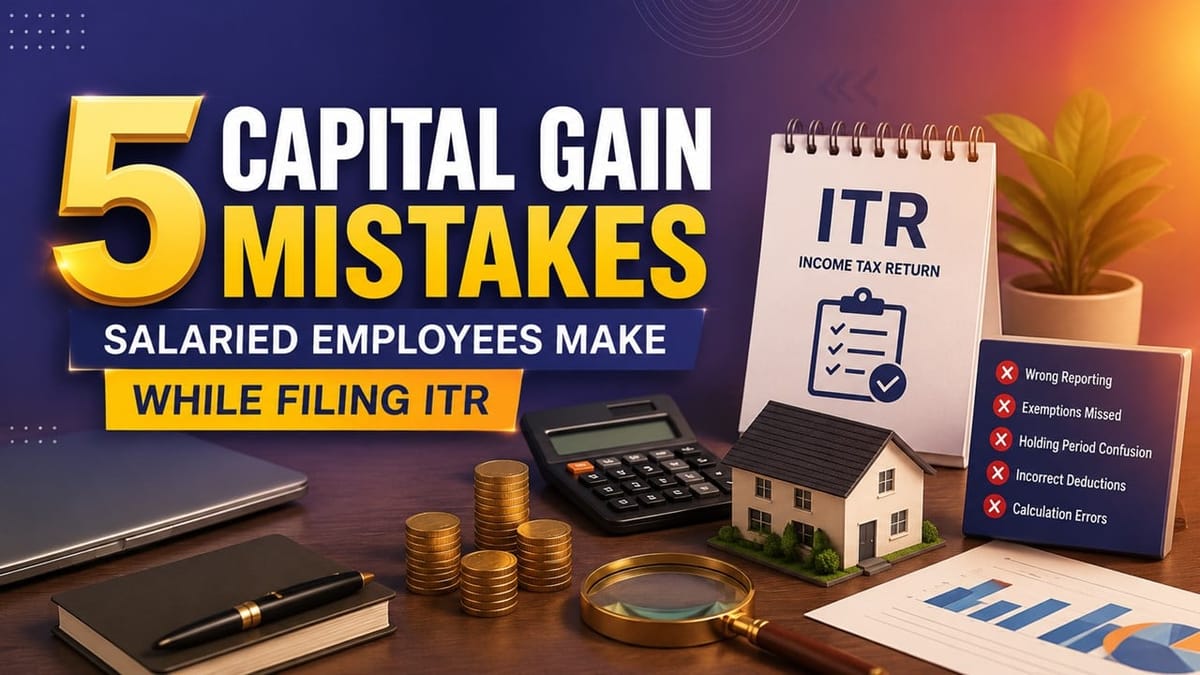

5 Capital Gain Mistakes Salaried Employees Make While Filing ITR
Every year, thousands of salaried professionals in India sell shares, mutual funds, or property and assume their tax filing ends with their Form 130 (previously Form 16). What they miss is that capital gains have a separate reporting requirement in ITR, and errors in this section attract notices, demand letters, and penalties from the income tax department.
Having worked with salaried taxpayers for over seven years, I have seen the same mistakes repeat every filing season. This article covers the five most common capital gains errors and exactly how to avoid them.

This is the most common and most dangerous mistake. Many salaried employees believe that since their employer deducts TDS on salary and the tax is already paid, they do not need to report anything else.
Capital gains from equity, mutual funds, or property are completely separate from salary income. They must be reported in your ITR even if the gain is below the taxable threshold.

Why this matters: The income tax department receives information about your transactions directly from stock exchanges, mutual fund houses, and registrars through the Annual Information Statement (AIS). If your AIS shows a share sale but your ITR shows no capital gains, an automated notice under Section 143(1) is triggered.
ITR-1 (Sahaj) does not have a capital gains schedule. It is meant only for salaried individuals with income from salary, one house property, and other sources up to Rs. 50,000.
The moment you have any capital gains from shares, mutual funds, or property, you must file ITR-2 (if you are salaried with no business income) or ITR-3 (if you also have business or professional income).
Filing ITR-1 when you should have filed ITR-2 is treated as a defective return. The income tax department will send a defect notice under Section 139(9) asking you to file a revised return in the correct form within 15 days. Missing this deadline can result in your return being treated as invalid.
The tax rate on capital gains depends entirely on whether the gain is short-term or long-term. And the holding period that determines this varies by asset class. Many salaried taxpayers apply the wrong holding period and end up paying the wrong tax rate.
Correct holding periods for FY 2025-26:
| Asset | Holding Period for LTCG |
|---|---|
| Listed equity shares | More than 12 months |
| Equity mutual funds | More than 12 months |
| Debt mutual funds | More than 24 months |
| Property (land/building) | More than 24 months |
| Gold and jewellery | More than 24 months |
| Unlisted shares | More than 24 months |
Tax rates FY 2025-26:
| Type | Asset | Tax Rate |
|---|---|---|
| STCG | Listed equity, equity MF | 20% (Section 111A) |
| LTCG | Listed equity, equity MF | 12.5% above Rs. 1.25 lakh (Section 112A) |
| STCG | Property, gold, debt MF | Slab rate |
| LTCG | Property, gold | 20% without indexation (Section 112) |
| LTCG | Debt MF | Slab rate |
Common error: A taxpayer sells property held for 20 months and assumes it is LTCG because it has been held for a long time. But property requires 24 months for LTCG treatment. The gain would be taxed at slab rate as STCG.
Under Section 112A, LTCG from listed equity shares and equity mutual funds up to Rs. 1.25 lakh per financial year is completely exempt from tax. Only the amount above Rs. 1.25 lakh is taxed at 12.5%.
Many salaried taxpayers either:
Example: Priya, a software engineer in Bengaluru, redeems equity mutual funds in December 2025 with an LTCG of Rs. 2,00,000.
Taxable LTCG = Rs. 2,00,000 – Rs. 1,25,000 = Rs. 75,000 Tax at 12.5% = Rs. 9,375
If Priya had not known about this exemption, she would have paid Rs. 25,000 in tax on the full gain. The Rs. 1.25 lakh exemption saved her Rs. 15,625.
When a salaried professional sells long-term capital assets like shares, gold, or land and reinvests the proceeds into a residential house, Section 54F provides a complete or partial exemption from capital gains tax.
Most salaried taxpayers are completely unaware of this provision. They pay full capital gains tax on share or gold sales without realising that a planned house purchase could have sheltered the entire gain.
How it works:
Example: Rahul sells listed shares in January 2026 with a net sale consideration of Rs. 40 lakh and LTCG of Rs. 15 lakh. He purchases a flat for Rs. 40 lakh in March 2026.
Since he reinvested the full sale consideration, the entire Rs. 15 lakh LTCG is exempt under Section 54F. Tax saved: Rs. 1,87,500 (at 12.5%).
Key conditions to remember:
Before you submit your ITR this July, go through this checklist:
Diksha Chawla is an MBA Finance professional with 7 years of experience in income tax education. She is the founder of finlecture.in, a platform dedicated to helping salaried professionals and freelancers navigate Indian income tax with clarity and confidence.

In case of any Doubt regarding Membership you can mail us at [email protected]
Join Studycafe's WhatsApp Group or Telegram Channel for Latest Updates on Government Job, Sarkari Naukri, Private Jobs, Income Tax, GST, Companies Act, Judgements and CA, CS, ICWA, and MUCH MORE!"