GST department cannot issue one single Show Cause Notice for multiple financial years: High Court:
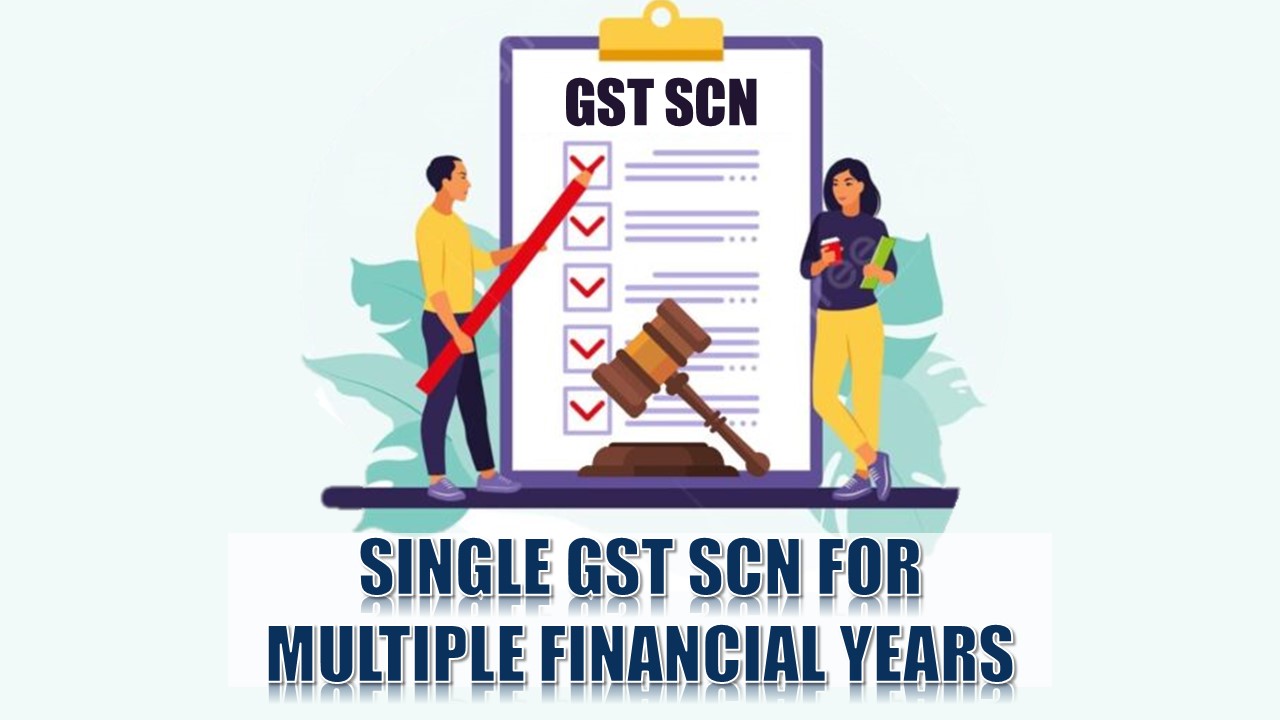
Madras High Court ruled that it is illegal to issue a single GST Show Cause Notice for multiple financial years under Sections 73 and 74 of the GST Act.
Madras HC Bars Single GST SCN for Multiple Financial Years
 Saloni Kumari
 Jul 24, 2025
GST department cannot issue one single Show Cause Notice for multiple financial years: High Court
One common question arises in the minds of numerous taxpayers: Can the GST department issue one single Show Cause Notice (SCN) indicating multiple financial years?
Recently, multiple writ petitions have been filed in Madras High Court on the issue of “Bunching of Show Cause Notices”, meaning the issuance of a single show cause notice (SCN) for more than one financial year. As all these petitions are being filed on the same matter and the relief asked in them is interconnected, the High Court heard them together and passed a common order for all.
This judgment deals with how show cause notices (SCNs) should be issued under the Goods and Services Tax (GST) Act, particularly under Sections 73 and 74 of the Act. The court has announced its ruling on whether the tax department can issue a single SCN covering more than one financial year or whether each financial year must be treated separately when issuing SCNs.
Sub-section (1) of Section 73/74 of the GST Act says that the authorities (respondents) are allowed to issue a show cause notice (SCN) to the individual chargeable with tax asking him/her to explain the reason why the mentioned tax amount should not be imposed on him/her or why he/she is not eligible to pay that tax amount mentioned in the notice for various situations listed in it. This SCN notice can be issued under conditions when tax is not paid, it is short paid, or it is wrongly refunded, or when wrong input tax credit is claimed, but without/with intent to evade tax, respectively.
Section 73(2)/74(2) requires the SCN to be issued within at least 3 months (in the case of Section 73) or 6 months (in the case of Section 74) before the time limit for passing the assessment order. Section 73(10)/74(10) says that the final assessment order should be issued within 3 years (Section 73) or 5 years (Section 74) from the last date of filing the annual return for the relevant financial year.
According to Section 2(106) of the GST Act, a “tax period” means the time for which the return is required to be furnished. So, it can be monthly or annually. Section 73(3)/74(3) says that once an SCN is issued for “any period,” the officer may issue statements for other tax periods that are not covered in the initial SCN.
The department argued that “any period” could mean multiple financial years combined. However, the Court disagreed, explaining that “any period” must be read in line with the definition of “tax period,” which means either a specific month or a financial year.
For the question, the GST department issues one single Show Cause Notice (SCN) indicating multiple financial years. The high court ruled 'No,' as the GST law sets specific time limits for each financial year: 3 or 5 years from the last date of filing that annual return of the year.
That means each financial year is treated as a separate unit. Hence, the department cannot club multiple financial years into a single show cause notice, as it violates the prescribed limitation period. It treats multiple tax periods as one, which the law does not permit.
Now the question was also about issuing statements for other periods? The high court ruled that if an SCN is issued for a particular tax period, the department may serve a statement for other months or periods within the same financial year, as long as the reason (grounds) for the demand is the same. However, these statements cannot be extended to other financial years.
Therefore, in final judgement, the high court issued the following orders:

- SCNs must be issued based on tax periods; if based on monthly returns, the SCN can be issued for specific months. If based on annual return, then it can be issued for that entire financial year.
- When annual returns are already filed, SCNs should be issued based on the financial year, not month-by-month. The GST department cannot issue a single SCN covering more than one financial year, as it violates the GST Act. Additionally, it messes with the limitation period because each financial year has its own separate limitation.
- Since in this case the department issued combined SCNs covering multiple years, the court held that such SCNs are invalid and hence quashed them all and allowed all writ petitions.
About Author


Saloni Kumari
Content Writer
Saloni is a Content Writer with 2+ years of experience at studycafe.in. She writes legal, taxation, and finance related content including GST, Income Tax etc. Skilled in translating complex judicial pronouncements and regulatory developments into clear, and reader-friendly articles. Experienced in covering judgements of ITAT, High Court, GSTAT, and news related to Income Tax, GST, and corporate law. She can be reached at [email protected].
Saloni is a Content Writer with 2+ years of experience at studycafe.in. She writes legal, taxation, and finance related content including GST, Income Tax etc. Skilled in translating complex judicial pronouncements and regulatory developments into clear, and reader-friendly articles. Experienced in covering judgements of ITAT, High Court, GSTAT, and news related to Income Tax, GST, and corporate law. She can be reached at [email protected].
 StudyCafe
 Delhi, Delhi, India
 2922
2922My Recent Articles
- GSTN Introduces New E-Invoicing Facility for Self-Invoices Under Reverse Charge Mechanism
- Flexi Cap vs Multi Cap Funds: What's the Real Difference?
- IBA Recommends Public Sector Banks to Reduce Ambit of Physical Branch Audits to 50% of Total Business
- ITAT Directs AO to Reconsider Rs 16.44 Lakh Capital Gains and Rs 25.87 Lakh Stamp Duty Value Addition
- ITAT Remands Rs 3.33 Crore Demonetisation Cash Deposit Case to AO, Directs Rs 10,000 Relief Fund Payment
Up Next
Loading suggestions…


Recent Posts



All Posts

Recent Posts
All Posts