CAG Report Highlights Major GST E-Way Bill Irregularities in Jammu and Kashmir
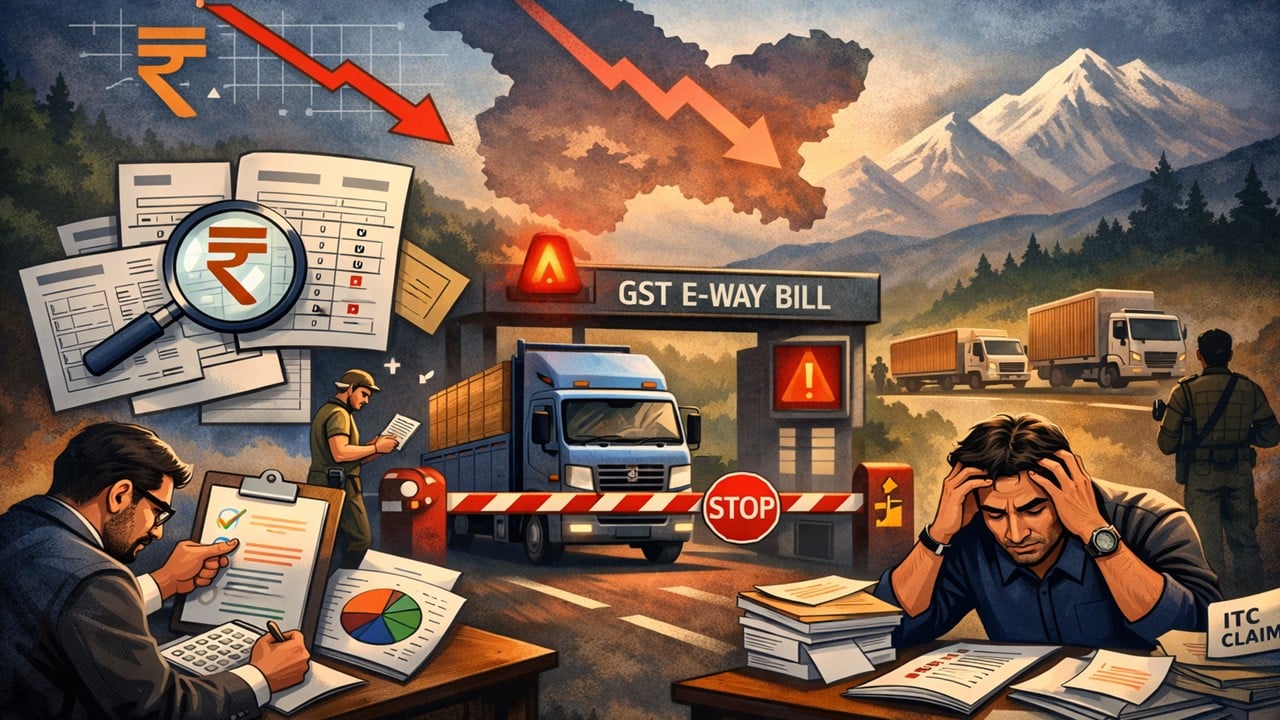
Many major flaws have come to light in the recent report regarding the e-way bill system of GST in Jammu and Kashmir. This report is from the Comptroller and Auditor General (CAG), in which it is clearly stated that the system was implemented but was not followed properly.
The e-way bill system was
launched in April 2018 so that information about the movement o
f goods worth more than Rs 50,000 can be recorded in advance. Interstate (between states), it was implemented at the same time, whereas in
Jammu and Kashmir, intrastate (inside the state).
The audit found that some taxpayers who
were not eligible for the scheme still remained in the Composition
Levy scheme. Apart from this, many taxpayers filed ‘
nil’ returns or
did not file returns at all, even though they had generated
e-way bills. In these cases, a tax effect of about
Rs 2.29 crore was revealed.
Another big case came to light between
2018 and 2022. Three taxpayers registered in two assessment circles generated a total of
5,739 e-way bills, involving tax of approximately
Rs 67.99 crore. But when the return (GSTR-3B) was viewed, only Rs 64.24 crore was shown in it. That means a difference
of about Rs 3.75 crore was found. The biggest problem was that there was no proper reconciliation between
GSTR-1 and GSTR-3B, due to which it was not known on which invoices tax was not paid.
The report also revealed that many e-way bills were created by
people whose registration had already been cancelled. In some cases, the
vehicle numbers were also incorrect, such as for scrapped vehicles, two-wheelers, or vehicles whose registration was suspended or cancelled. At many places, multiple e-way bills were also created on the same invoice.
Now, if we talk about
enforcement (investigation and action), there was a big deficiency there too. There was a huge shortage of staff in the Enforcement Wing
between 2018 and 2022. There were
29 to 55% vacancies in state tax officers,
43 to 72% in inspectors,
54 to 71% in sub-inspectors, 36 to 92% in head guards, 7
7 to 86% in guards, and
71 to 83% in drivers. It is clear that with so few staff, it became difficult to do proper monitoring.
Apart from this
, no fixed target was set for checking e-way bills. In
47 cases, the physical verification report
(Form MOV-04) was also not prepared, due to which it could not be confirmed whether the assessment of the
goods was correct or not. The Grievance Redressal Officer, who should have been there for complaints, was also not appointed.
Many other irregularities came to light in the report, like
late fees not being levied for late filing of returns, interest not being charged on tax late deposits, and delays in cancellation of registration and
GSTR-10 returns also not filed in many places. In some cases, action was initiated but not completed.
Apart from all this, irregularities were also found on a large scale, like less or no payment of interest, an outstanding amount of tax, wrongly taking
Input Tax Credit (ITC), a difference in returns, and availing the benefit of ITC without depositing tax by the supplier. Taking all these cases together, the total tax effect was
Rs 439.36 crore.
 Kashish Bhardwaj
 Apr 14, 2026




 StudyCafe
 Delhi, Delhi, India
 176
176