GST Department cannot use its power to freeze bank accounts indefinitely: High Court:
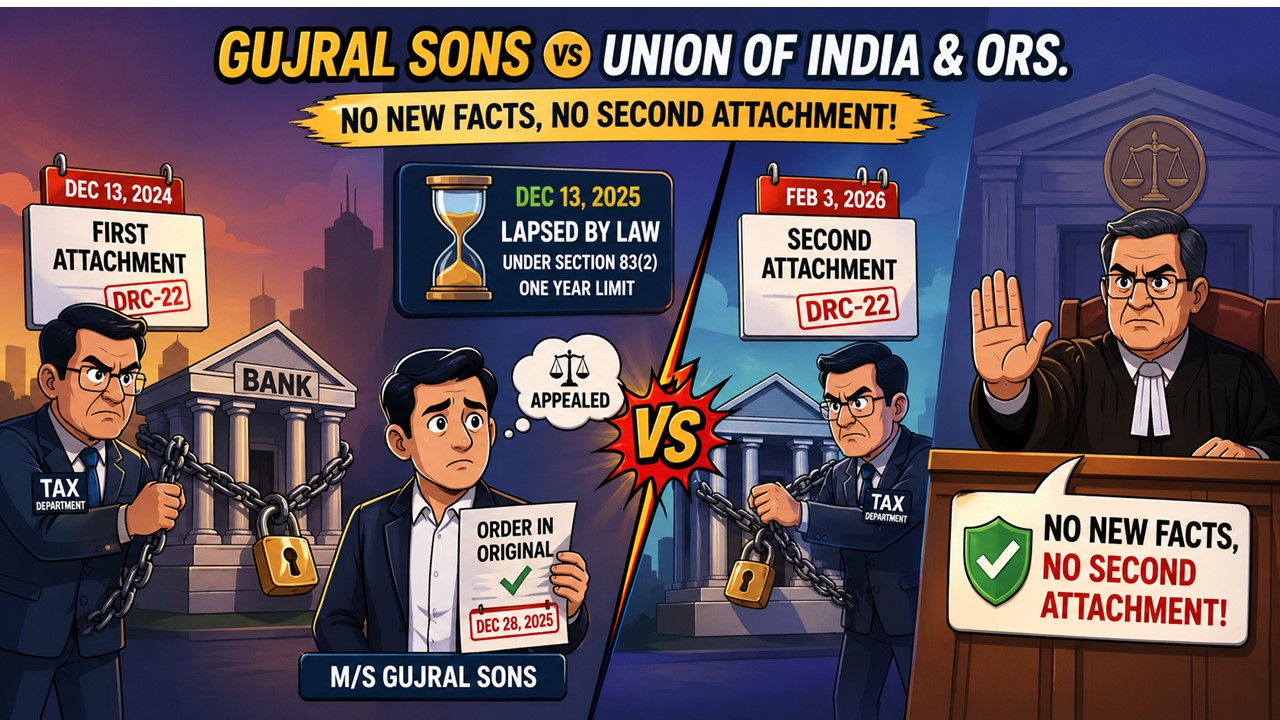
The court reaffirmed that the one-year lifespan of a provisional attachment under Section 83(2) of the CGST Act is absolute and cannot be circumvented.
Why the courts are putting an end to the cycle of repeated provisional attachments under the CGST Act
 Khushi Jain
 May 1, 2026
M/S Gujral Sons vs Union of India is a landmark reminder that the government cannot use its power to freeze bank accounts indefinitely under Section 83 of the CGST Act.
In this case, the authorities had frozen the petitioner's bank account for one year, which expired on December 13, 2025, per the law's absolute one-year limit. Despite this, the tax department issued fresh attachment orders in February 2026 based on the exact same facts to keep the account blocked while an appeal was pending.
The petitioner successfully argued that this second attachment was unsustainable, as it was based on the same factual matrix without any new circumstances or facts to justify a renewed exercise of draconian powers under Section 83 of the Act.
Issue of the case
Whether the Tax Authorities have the power to issue a fresh/renewal provisional attachment order after the initial one-year period prescribed by Section 83(2) has lapsed, particularly when there is no change in circumstances?
Decision of the Court
The Delhi High Court ruled that the government cannot bypass the law by repeatedly freezing a taxpayer's bank accounts once the initial one-year limit has expired.
The Court explained that "provisional attachment" is only a temporary emergency measure meant for use during an active investigation, not a tool for permanent debt collection after a case is closed.
Because the government tried to issue a second freeze using the exact same reasons as the first without showing any new evidence or changed circumstances and the Court declared the action illegal.
Essentially, the ruling confirms that the one-year legal deadline is a strict protection for citizens, and the "Revenue" (the Tax Department) cannot simply hit a "renewal" button to keep someone's finances locked up indefinitely.
About Author


Khushi Jain
Legal Content Writer
 StudyCafe
 Delhi, Delhi, India
 80
80My Recent Articles
- ROC Chennai Orders Penalty for delay in filing MGT-17: Short Staff no Excuse
- Penalty Order Passed by ROC Chennai for Non-Disclosure in Form PAS-3
- ROC Imposes Penalty For Non-Compliance In Securities Allotment Filing
- GST: Bombay High Court Upholds Validity of Manual Appeal
- From Rs. 275 Crore to Zero: United Breweries Gets Relief in Sales Tax Dispute
Up Next
Loading suggestions…


Recent Posts

All Posts



Recent Posts
All Posts