SEBI Proposes to Introduce Price Bands for Gold and Silver ETFs:
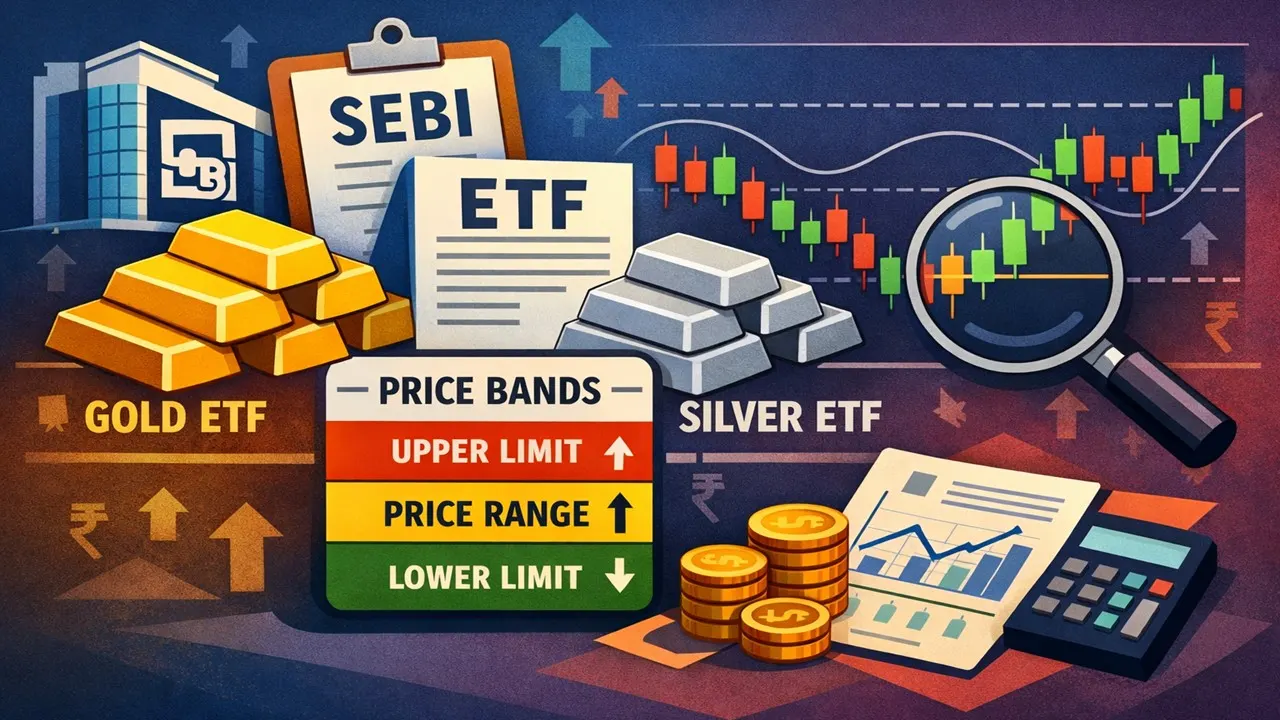
Due to unusual price volatility, the SEBI has proposed to introduce a +/-20% price band on Gold and Silver Exchange Traded Funds (ETF).
Gold and Silver ETFs to Have Price Band
 Nidhi
Nidhi Feb 16, 2026
SEBI Proposes to Introduce Price Bands for Gold and Silver ETFs
Over the past few weeks, the price of gold and silver has faced significant fluctuations due to the US Federal Reserve interest rate cuts, the volatile US dollar, and the high demand of central banks. Due to this unusual price volatility, the Securities and Exchange Board of India (SEBI) has proposed to introduce a +/-20% price band on Gold and Silver Exchange Traded Funds (ETF).
Additionally, the board has also proposed graded price bands for ETFs on debt and equity indices with a +/-20% range.
The Board has closely monitored the price bands and circuit filters for the ETFs. SEBI said that the price fluctuations of gold and silver in the foreign markets could affect the part of the price band.
SEBI released a seven-page consultation paper, where it is proposed that gold and silver ETFs will have an initial price band of +/-6%. This limit can be flexed up to +/-20% during the trading day. Once this limit is reached, trading will be paused for 15 minutes. After this cooling-off period, the price band can be flexed by 3%.
As per the consultation paper, if an international gold or silver price is more than the total daily price limit of 9%, stock exchanges may further relax the limit in stages of 3%, with a 15-minute cooling-off period. The single-day variation cannot be more than +/-20%.
SEBI has suggested applying a similar price band for debt and equity ETFs.
The regulator has proposed that the price band can be flexed only twice in one day. For any relaxation after 9.90%, there must be at least 50 trades involving 10 unique UCCs (Unique Client Codes) and three trading members on both sides of the trade.
About Author


Nidhi
Content Writer
Nidhi is a skilled content writer specializing in personal finance. She creates clear, engaging articles on mutual funds, investments, insurance, and wealth-building strategies. With a passion for simplifying complex financial topics, Nidhi helps readers make informed money decisions with confidence. She can be reached at [email protected]
Nidhi is a skilled content writer specializing in personal finance. She creates clear, engaging articles on mutual funds, investments, insurance, and wealth-building strategies. With a passion for simplifying complex financial topics, Nidhi helps readers make informed money decisions with confidence. She can be reached at [email protected]
 Studycafe
 New Delhi, Delhi, India
 1832
1832My Recent Articles
- Karnataka High Court Gives Another Chance in GST Matter Due to Lack of Hearing
- Delay Should Be Condoned if Explanation is Unrefuted: ITAT
- Non-Service of Income Tax Notice, Ill health of taxpayer, ITAT condones Appeal filing delay
- Books of Accounts Cannot be Rejected Without Any Specific Defect: ITAT Kolkata
- Karnataka High Court Sends ITC Matter Back to GST Authorities for Reconsideration
Up Next
Loading suggestions…


Recent Posts



All Posts


Recent Posts
All Posts