Think Your Big Transactions Go Unnoticed? Income Tax Department Is Already Watching:
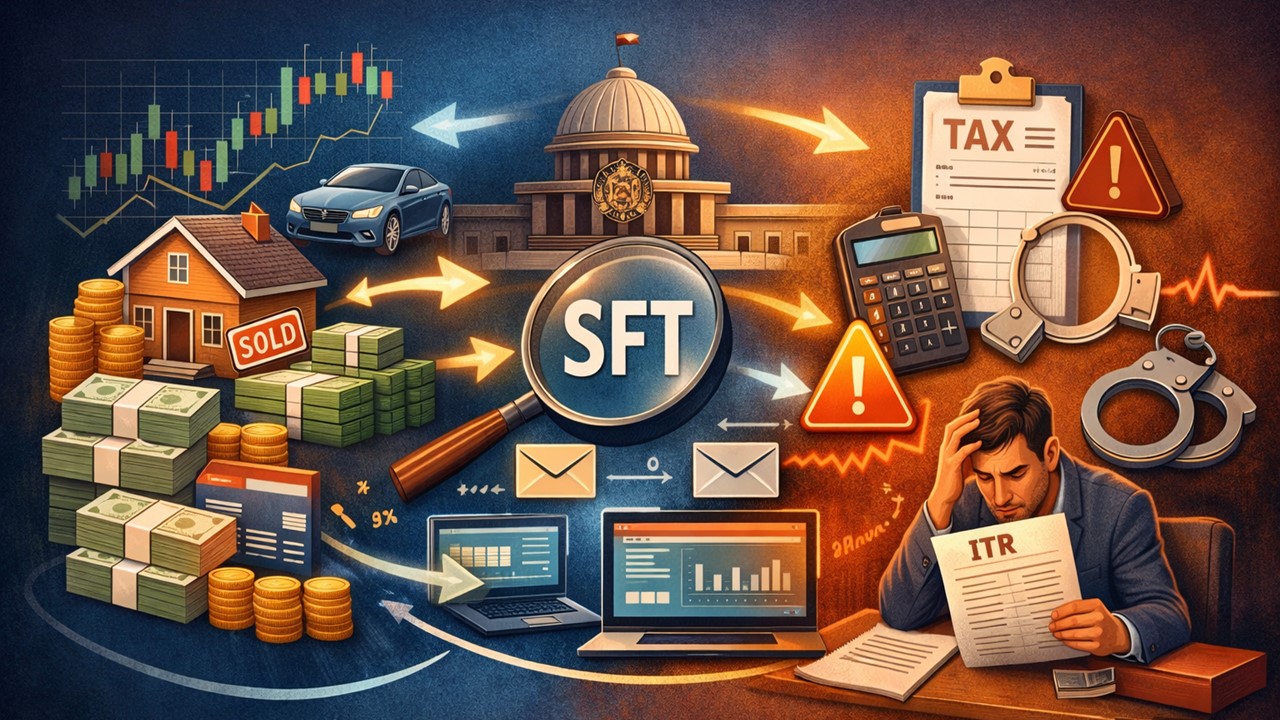
High-value financial transactions are automatically reported to tax authorities under the Statement of Financial Transaction (SFT), making non-disclosure in ITRs risky.
Understand How SFT Framework Puts Your ITR Under the Scanner
 Saloni Kumari
 Feb 26, 2026
Think Your Big Transactions Go Unnoticed? Income Tax Department Is Already Watching
Several taxpayers think non-disclosure of high-valued transactions in income tax returns (ITRs) is not noticed by the tax authorities. However, they are wrong. Activities in which high-valued transactions are made, such as cash deposits, property purchases, mutual fund investments, etc., are now automatically reported to the Income Tax Authorities through the Statement of Financial Transaction (SFT).
Now, numerous taxpayers are not even aware of what SFT is, so it is a compulsory reporting framework under which financial institutions, companies, and registrars are required to share details of high-valued transactions made by taxpayers with the Income Tax Department.
These reports are shared with the tax department electronically, usually before May 31 after the end of a financial year. Some transaction details related to the market, like those involving listed securities or mutual funds, are shared even more quickly.
The SFT framework has been introduced to find out income discrepancies, undisclosed investments, and suspicious cash utilisation. Several transactions are reported when their value crosses a certain limit. Here is a list of such limits:
Banking and cash transactions
- Cash deposits of Rs 10 lakh or more in savings accounts in a financial year
- Cash deposits or withdrawals of Rs 50 lakh or more in current accounts
- Cash payments above Rs 10 lakh for bank drafts, payment orders, or prepaid instruments
- Cash payments of Rs 1 lakh or more as annual credit card bills
- Total credit card payments exceeding Rs 10 lakh in a year through any mode
- Fixed or term deposits exceeding Rs 10 lakh (excluding renewals)
- Shares
- Bonds or debentures
- Share buybacks worth over Rs 10 lakh
- Purchase or sale of immovable property valued at Rs 30 lakh or more
- Cash payments exceeding Rs 2 lakh for goods or services
- Forex purchases or foreign currency expenses above Rs 10 lakh annually
About Author


Saloni Kumari
Content Writer
Saloni is a Content Writer with 2+ years of experience at studycafe.in. She writes legal, taxation, and finance related content including GST, Income Tax etc. Skilled in translating complex judicial pronouncements and regulatory developments into clear, and reader-friendly articles. Experienced in covering judgements of ITAT, High Court, GSTAT, and news related to Income Tax, GST, and corporate law. She can be reached at [email protected].
Saloni is a Content Writer with 2+ years of experience at studycafe.in. She writes legal, taxation, and finance related content including GST, Income Tax etc. Skilled in translating complex judicial pronouncements and regulatory developments into clear, and reader-friendly articles. Experienced in covering judgements of ITAT, High Court, GSTAT, and news related to Income Tax, GST, and corporate law. She can be reached at [email protected].
 StudyCafe
 Delhi, Delhi, India
 2924
2924My Recent Articles
- Major Relief in Arbitration Case: MCIA Denies Rs 908 Crore Statement Claim Made by Allied Silica Against Tata Chemicals
- MCA and ICSI to Hold User Awareness Session on Form AOC-4 Filing Amid Glitches on MCA-21 Version-3 Portal
- GSTN Introduces New E-Invoicing Facility for Self-Invoices Under Reverse Charge Mechanism
- Flexi Cap vs Multi Cap Funds: What's the Real Difference?
- IBA Recommends Public Sector Banks to Reduce Ambit of Physical Branch Audits to 50% of Total Business
Up Next
Loading suggestions…


Recent Posts
All Posts


Tags
Recent Posts
All Posts