Assessment Order Cannot Be Passed Against Non-Existent Entity: ITAT Rules in Favour of Bank of Baroda:
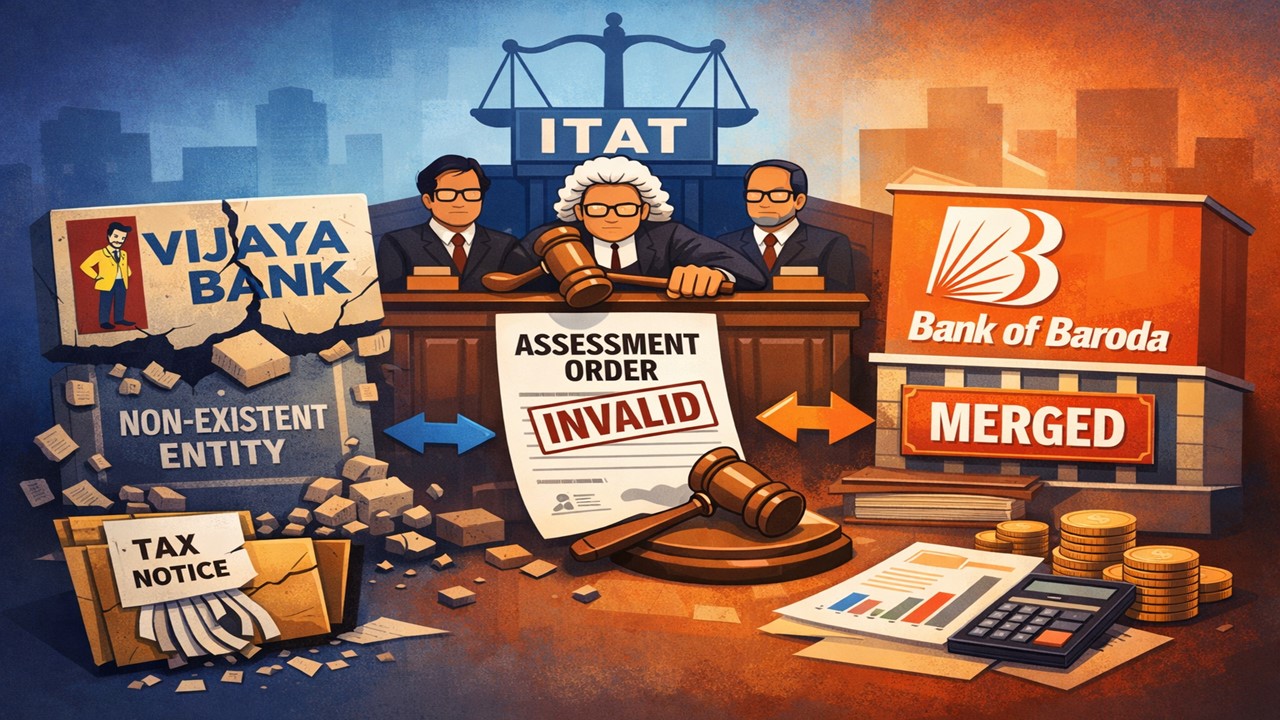
The ITAT ruled that notices and the consequential assessment order passed in the name of the dead entity are invalid if the AO is aware of the amalgamation.
ITAT Rejects Revenue's Appeal in Bank of Baroda Case
 Nidhi
Nidhi Feb 12, 2026
Assessment Order Cannot Be Passed Against Non-Existent Entity: ITAT Rules in Favour of Bank of Baroda
The Income Tax Appellate Tribunal (ITAT), Mumbai, provided significant relief to the Bank of Baroda by quashing an order issued against Vijaya Bank, which had merged with the Bank of Baroda. The ITAT ruled that passing an order against a non-existent entity is invalid and bad in law.
Vijay Bank and Dena Bank had amalgamated with Bank of Baroda (assessee) in 2019. The assessee bank had filed its return for the assessment year 2019-20, where it had declared a loss of Rs 1418,82,57,594 and claimed a refund of Rs 694,13,11,216. The case was selected for scrutiny due to several issues, including high creditors/liabilities, TDS mistakes, refund claims, currency fluctuation losses, unsecured loans, capital gains, business expenses, etc.
The AO issued an assessment order under section 143(3) read with section 144(B) of the Income Tax Act, after making some disallowances. The CIT(A) partly allowed the assessee's appeal.
The main contention of the assessee was that the assessment order was passed against Vijaya Bank, which ceased to exist after it was merged with Bank of Baroda. The assessee argued that the assessment order should have been passed in the name of the amalgamated entity (Bank of Baroda) instead of the amalgamating entity (Vijaya Bank).
The revenue on the other side argued that passing an order against a non-existent entity is a procedural defect, or rather a curable mistake under section 292(B) of the Income Tax Act, and that such a mistake should not invalidate the assessment proceeding.
The ITAT agreed with the Bank of Baroda's contention, observing that the assessing officer, despite being aware of the amalgamation, passed the order in the name of the amalgamating entity, which did not even exist at that time. Therefore, the ITAT ruled that notices and the consequential assessment order passed in the name of the dead entity are invalid if the AO is aware of the amalgamation.
Accordingly, the tribunal quashed the assessment order, declaring it null and void. The revenue's appeal was dismissed.
About Author


Nidhi
Content Writer
Nidhi is a skilled content writer specializing in personal finance. She creates clear, engaging articles on mutual funds, investments, insurance, and wealth-building strategies. With a passion for simplifying complex financial topics, Nidhi helps readers make informed money decisions with confidence. She can be reached at [email protected]
Nidhi is a skilled content writer specializing in personal finance. She creates clear, engaging articles on mutual funds, investments, insurance, and wealth-building strategies. With a passion for simplifying complex financial topics, Nidhi helps readers make informed money decisions with confidence. She can be reached at [email protected]
 Studycafe
 New Delhi, Delhi, India
 1832
1832My Recent Articles
- Karnataka High Court Gives Another Chance in GST Matter Due to Lack of Hearing
- Delay Should Be Condoned if Explanation is Unrefuted: ITAT
- Non-Service of Income Tax Notice, Ill health of taxpayer, ITAT condones Appeal filing delay
- Books of Accounts Cannot be Rejected Without Any Specific Defect: ITAT Kolkata
- Karnataka High Court Sends ITC Matter Back to GST Authorities for Reconsideration
Up Next
Loading suggestions…


Recent Posts


All Posts


Tags
Recent Posts
All Posts