Income Tax applicability on Retirement Benefits:
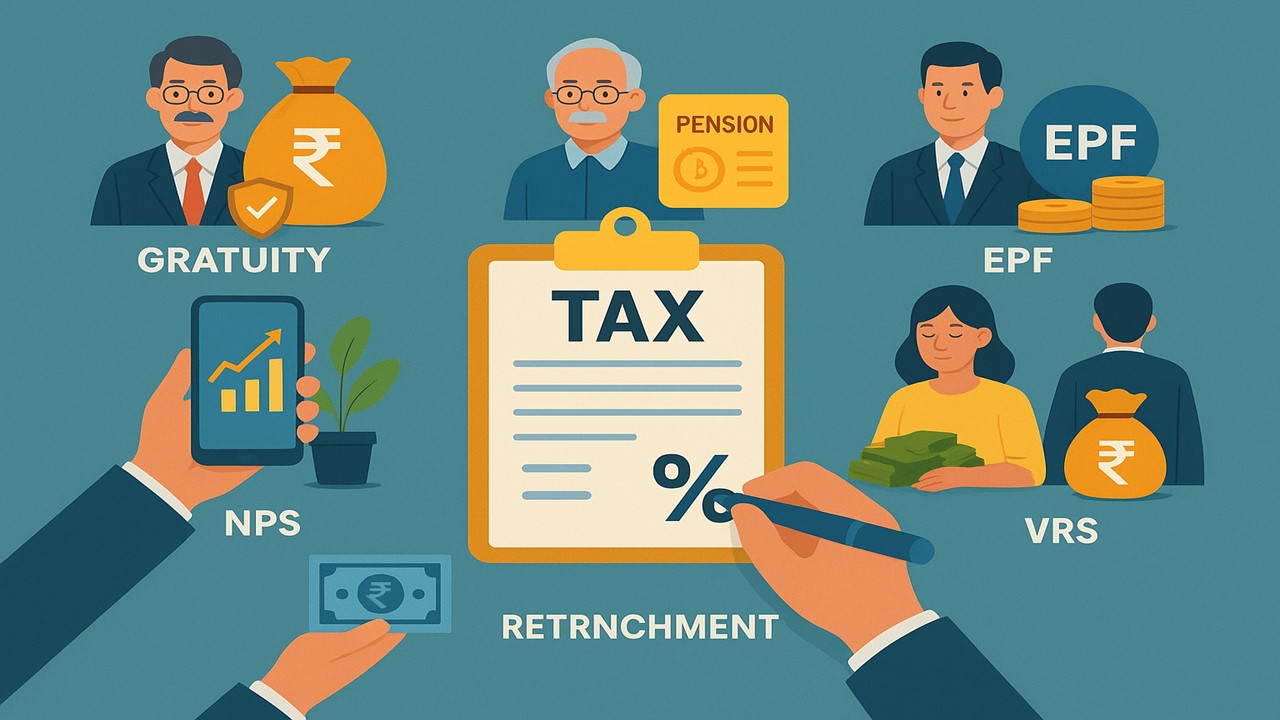
A comprehensive summary of the tax treatment of gratuity, pension, EPF, NPS, leave encashment, VRS, and retrenchment compensation.
Retirement Benefits and Their Tax Implications
 Vanshika verma
 Nov 22, 2025
Income Tax applicability on Retirement Benefits
Retirement benefits are important because they give financial support to employees after they stop working. In India, employers offer several types of retirement benefits. The most common ones are the Employee Provident Fund (EPF) and the National Pension System (NPS), which are savings schemes where both the employee and employer put in money regularly to build a retirement fund. Employees also receive gratuity, which is a lump sum paid for their service, and they can encash their unused leave when they retire. If an employee is eligible for a pension, they may get a part of it upfront as a commuted pension. In cases where an employee chooses voluntary retirement or is asked to leave due to retrenchment, they may receive additional compensation. The taxability of these retirement benefits under the Income-tax Act is as follows:
Gratuity
An employer must pay gratuity to an employee who has worked continuously for at least five years and leaves the company because of retirement, resignation, or superannuation. In cases where the employee dies or becomes disabled, the employer must pay gratuity even if the five-year rule is not completed. The taxability of gratuity will be as under:
For tax purposes, any gratuity received while still in service is fully taxable. Gratuity received at retirement is fully tax-free for government employees (other than employees of statutory corporations)
For employees who are covered under the Gratuity Act, 1972, the death-cum-retirement gratuity they receive is tax-free only up to a certain limit. The tax-free amount will be the lowest of these three:
(1) the amount calculated using the formula (*15/26) X last drawn salary X completed year of service or part thereof more than 6 months.
(2) Rs 20 lakh, or
(3) The actual gratuity received. For this calculation, "salary" means the last drawn basic pay plus dearness allowance (only the part that counts for retirement benefits), and it does not include bonus, commission, HRA, overtime, or any other allowances or perks. Any amount over the exempt limit becomes taxable.• For employees who are not covered under the Gratuity Act, 1972, and are not government employees, the tax exemption on death-cum-retirement gratuity is limited. The tax-free amount will be the lowest of three values:
(1) half a month’s average salary multiplied by the number of completed years of service,
(2) Rs 20,00,000, or
(3) the actual gratuity amount received. Here, "average salary" means the average of the employee’s basic pay and the part of dearness allowance that counts for retirement benefits, plus any turnover-based commission, taken for the last 10 months before retirement. Any gratuity received beyond the exempt limit becomes taxable.
Pension
Pension is the amount of money an employer gives to an employee after retirement or to the family after the employee’s death as a reward for the years of work they have completed. There are two types of pensions.
A. The first is commuted pension, which means the employee takes a lump-sum amount in advance by giving up a part of their monthly pension.
B. The second is an uncommuted pension, which is the regular monthly pension paid to the employee, just like a monthly salary after retirement.
- Uncommuted pension is fully taxable like regular income. Exception: Disability pensions of disabled armed forces personnel are fully tax-free.
- Family Pension (paid to family after employee’s death) is partly tax-free; one-third of the family pension or up to Rs 15,000 (whichever is less) is exempt. Exception: For families of armed forces personnel, the entire family pension is tax-free.
- A commuted pension received by an employee of government employees (Central/State/Local Authority/Statutory Corporation) is fully tax-free.
- Other employees who also receive gratuity: One-third of the commuted pension is tax-free.
- Other employees who do not receive gratuity: One-half of the commuted pension is tax-free.
- Received during the period of service is fully taxable.
- Received on the death of the employee is tax-free
- Encashment of unutilised earned leave at the time of retirement of government employees is tax-free.
- When an employee retires and receives money for their unused earned leave, a part of this amount can be tax-free. For non-government employees, the exempt amount is the lowest of four values: (a) The actual leave encashment received (b) The unutilised earned leave multiplied by the average monthly salary (c) ten months’ average salary, or (d) Rs 25,00,000

- The voluntary retirement compensation must be paid by an employer who is allowed to offer such a scheme.
- The scheme should genuinely reduce the number of employees in the organisation.
- The employee must have completed 10 years of service or be at least 40 years old (not required for public sector company employees).
- The company must not hire someone else to fill the position of the employee who took voluntary retirement, and the retiring employee cannot join another company under the same management.
- The employee must not have claimed a tax exemption for voluntary retirement in the past.
- The compensation amount must not exceed either three months’ salary for each completed year of service or the salary for the remaining months left until normal retirement, whichever is lower.
- For this calculation, "salary" means the last drawn basic salary + the part of the dearness allowance counted for retirement benefits + any commission received.
- The scheme must be available to all employees (workers and executives), except company directors or directors of co-operative societies.
- The employee must not claim Section 89 relief on the voluntary retirement amount.
- (a) Rs 500,000
- (b) Retrenchment compensation actually received
- (c) Average wage: 15/26 completed years of continuous service or any part thereof in excess of 6 months.
- (a) Rs 5,00,00
- (b) Retrenchment compensation actually received.
- (c) Average wage of three months.
- Employer's contribution under Recognised Provident Fund (RPF) is up to 12% of basic salary + DA is tax-free. But it can be taxable in these two cases: (a) Any contribution above 12%. (b) Any contribution above Rs 750,000.
- Employer contribution under Statutory Provident Fund (SPF) is not applicable. whereas under the Unrecognized Provident Fund (UPF), it is not taxable.
- An employee's contribution is eligible for deduction under Section 80C under Recognised Provident Fund (RPF) and Statutory Provident Fund (SPF). However, it is not eligible for deduction under Section 80C.
- Interest earned on PF under the Recognised Provident Fund (RPF) is exempt from tax. But it will be taxable in the following two scenarios: (a) Interest above the notified rate (b) Interest relating to the employee's contribution above Rs 5 lakh, in case no contribution is made by the employer (c) Interest relating to the employee's contribution above Rs 2.5 lakh, in case the employer has also contributed to the fund.
- Interest earned on PF under Statutory Provident Fund (SPF) is exempt from tax. But it will be taxable in the following scenarios: (a) Interest relating to the employee's contribution above Rs 5 lakh, in case no contribution is made by the employer (b) Interest relating to the employee's contribution above Rs 2.5 lakh, in case the employer has also contributed to the fund, whereas it is not taxable at the time of accrual under the Unrecognized Provident Fund (UPF).
- Withdrawal after 5 years under the Recognised Provident Fund (RPF) and Statutory Provident Fund (SPF) is exempt from tax. Whereas under the Unrecognised Provident Fund (UPF), the total of the following will be taxable: (a) Employer's contribution (b) Interest on employer's contribution and (c) Interest on employee's contribution.
- Withdrawal 5 years before under the Recognised Provident Fund (RPF) is calculated as if the fund were not recognised from the beginning. Withdrawal 5 years under the Statutory Provident Fund (SPF) is exempt. Whereas, under the Unrecognized Provident Fund (UPF), the following is taxable: (a) Employer's contribution (b) Interest on employer's contribution and (c) Interest on employee contributions.
- For Govt employees: Up to 14% of salary
- For Other employees: Up to 10% of salary
- If an employee is using the new tax regime, the employer contribution limit is 14% for everyone. (The benefit of additional deduction of up to Rs 50,000 under section 80CCD(1B) is also available to sums deposited to the account of a minor by a parent or guardian, effective from AY 2026-27.)
About Author


Vanshika verma
Content Writer
Vanshika Verma is a Content Writer with 1+ year of experience at Studycafe.in. A B.Com graduate from Delhi University, She writes articles on Finance, Tax, ICAI, GST, and the latest financial news, with a focus on making complex topics easy for readers and professionals.
Vanshika Verma is a Content Writer with 1+ year of experience at Studycafe.in. A B.Com graduate from Delhi University, She writes articles on Finance, Tax, ICAI, GST, and the latest financial news, with a focus on making complex topics easy for readers and professionals.
 Studycafe
 Delhi, Delhi, India
 2096
2096My Recent Articles
- Pinarayi Vijayan Moves Supreme Court Challenging Kerala High Court Order to Register FIR in CMRL Alleged Bribery Case
- CBI Lays Trap in Srinagar, Arrests SMC Ward Officer Red-Handed While Allegedly Accepting Rs 10,000 Bribe
- NIIT Limited Discloses Income Tax Department’s Appeal Before Delhi ITAT, Says No Adverse Financial Impact Expected
- Fake WhatsApp Boss Dupes Company Accountant of Rs 40 Lakh; Surat Police Arrest Haryana Man in Cyber Fraud Case
- Uttarakhand Tax Department Detects Rs 2.5 Crore Tax Evasion at Ramnagar Resort
Up Next
Loading suggestions…


Recent Posts


All Posts


Tags
Recent Posts
All Posts