ITAT Invalidates Entire Reassessment; Cites Breach of Section 148A(b) and Joint Ownership Error:
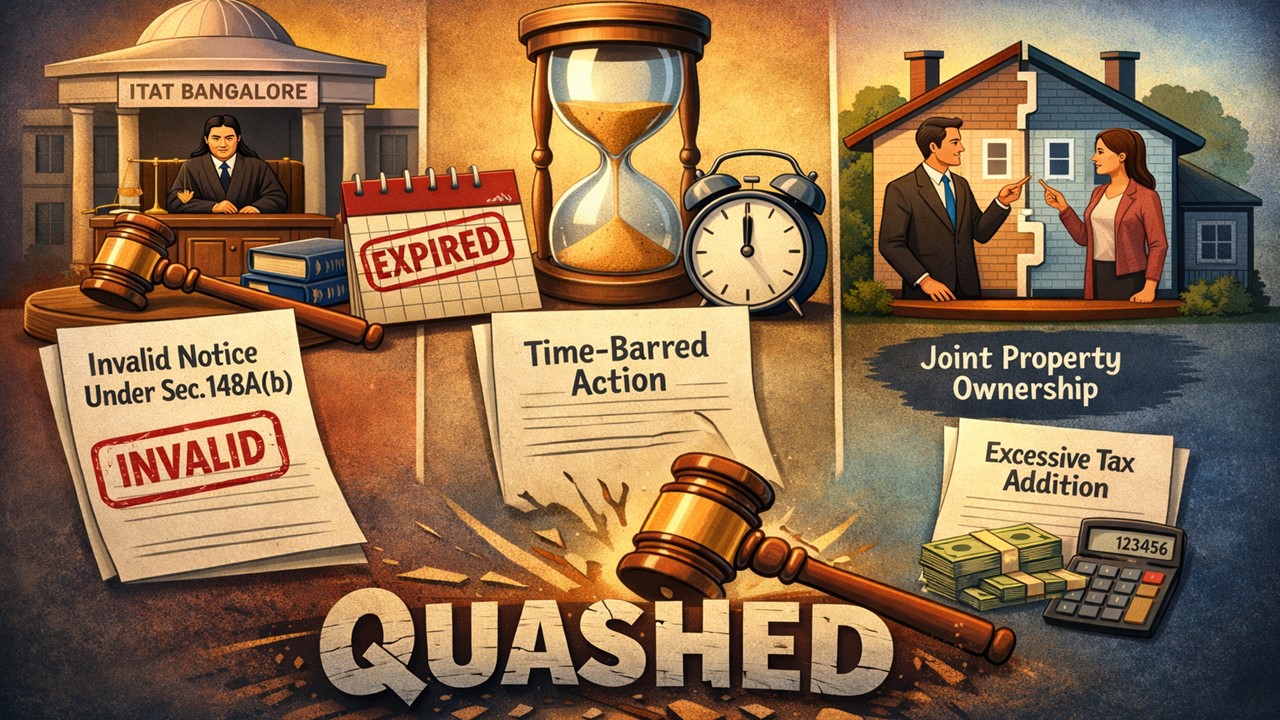
The ITAT quashed the reassessment proceedings against the assessee due to invalid notice under Section 148A(b), time-barred action, and improper full addition despite joint property ownership.
ITAT Strikes Down Entire Reassessment Proceedings
 Saloni Kumari
 Apr 17, 2026
ITAT Invalidates Entire Reassessment; Cites Breach of Section 148A(b) and Joint Ownership Error
ITAT Bangalore quashed the entire reassessment proceedings initiated against an immovable property, citing insufficient response time under Section 148A(b) notice and issuing it beyond the limitation. It also held additions unjustified since the property was jointly owned by the assessee and his wife; hence, making a full addition in the name of the assessee is not justified.
The assessee, Shri Mohammed Yousuf, had not initially filed its income tax return (ITR) for the Assessment Year 2015-16. The tax authorities received information that the assessee had not disclosed the purchases of immovable property, as well as the commission received by him. In conclusion, a notice under section 148 was issued to the assessee, wherein he was asked to file an ITR for the relevant year. The assessee filed its ITR; however, it did not respond to any of the notices issued thereafter.
The tax authorities had noted that the assessee had purchased an immovable property with a consideration of Rs 46.20 lakh as per the sale deed, while its stamp duty was of approximately Rs 58.53 lakh. Additionally, the assessee had not explained the source of the purchased immovable property. In conclusion, the tax authorities treated the entire investment as an unexplained investment under Section 69 of the Act and made the total difference value an addition to the assessee's income.
The aggrieved assessee filed an appeal before the ITAT Bangalore, challenging the legality of the reassessment. When the tribunal analysed the case, it noted that the notice issued under Section 148A(b) had given the assessee only 5 days of time to respond, while, as per the law, this time limit should be at least 7 days. This makes the notice invalid as per the law. Additionally, a Section 148 notice was issued after its statutory limit, i.e., beyond March 31, 2022, making the entire reassessment time-barred.
On the merits of the case, the tribunal noted that the property in question was jointly owned by the assessee and his wife. Therefore, the entire impugned addition cannot be made merely on the income of the assessee, and the tax authorities failed to consider this fact, although they had full access to the sale deed.
Considering all the aforementioned findings, the tribunal held the entire reassessment proceedings invalid and deleted the impugned additions. As a result, the appeal of the assessee was allowed.
About Author


Saloni Kumari
Content Writer
Saloni is a Content Writer with 2+ years of experience at studycafe.in. She writes legal, taxation, and finance related content including GST, Income Tax etc. Skilled in translating complex judicial pronouncements and regulatory developments into clear, and reader-friendly articles. Experienced in covering judgements of ITAT, High Court, GSTAT, and news related to Income Tax, GST, and corporate law. She can be reached at [email protected].
Saloni is a Content Writer with 2+ years of experience at studycafe.in. She writes legal, taxation, and finance related content including GST, Income Tax etc. Skilled in translating complex judicial pronouncements and regulatory developments into clear, and reader-friendly articles. Experienced in covering judgements of ITAT, High Court, GSTAT, and news related to Income Tax, GST, and corporate law. She can be reached at [email protected].
 StudyCafe
 Delhi, Delhi, India
 2860
2860My Recent Articles
- RBI Introduces New EDF Filing Rule for Freelancers, Influencers and Other Service Exporters, Effective October 1, 2026
- Sun Pharma Advanced Research Wins Rs 27.51 Crore CENVAT Credit Refund Dispute, Tribunal Dismisses Revenue's Appeal
- CBI Arrests Delhi Police Sub-Inspector in Rs 1 Lakh Bribery Case, Accused Caught While Accepting Rs 80,000
- Anup Engineering Secures Complete Relief in GST Dispute, Rs 3.32 Crore Demand Quashed
- Next-Gen GST 2.0 Reforms: GST Council May Ease Compliance Rules, Free Up Thousands of Crores in ITC
Up Next
Loading suggestions…


Recent Posts



All Posts


Recent Posts
All Posts