March 2026 Year-End: A Turning Point For Indian Taxpayers:
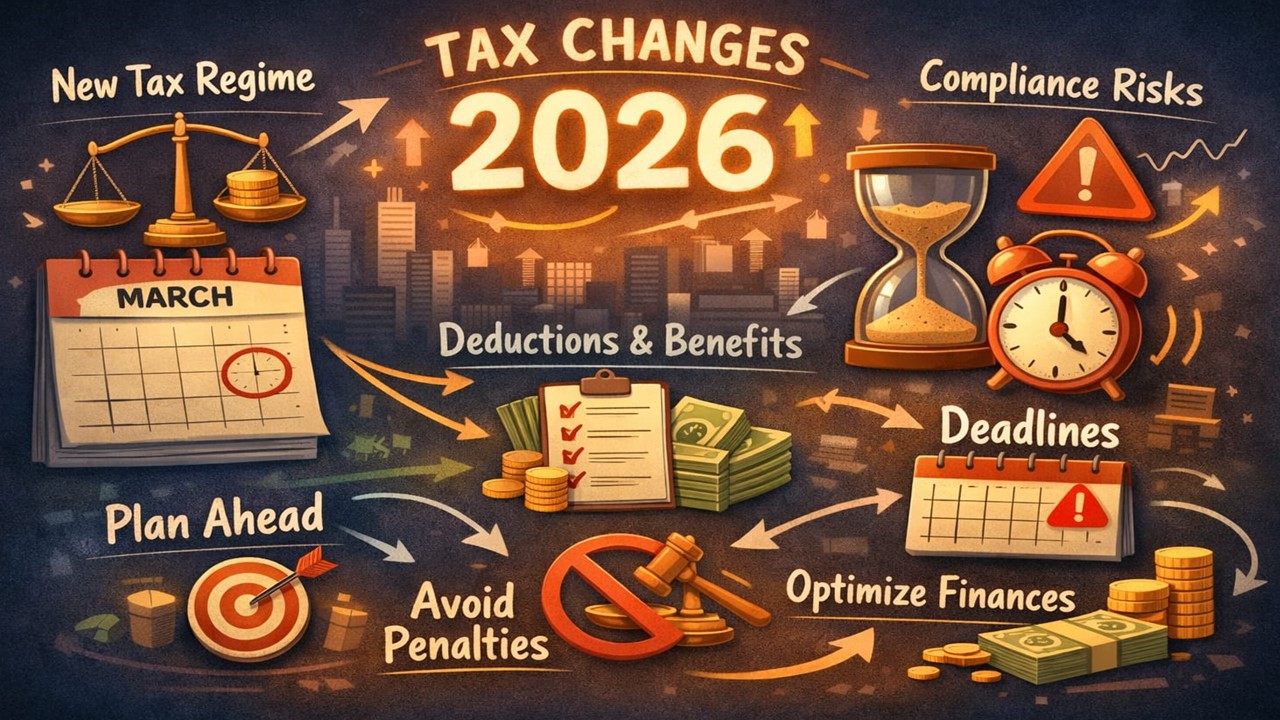
Know what you need to do before 31st March 2026: pay taxes, claim deductions, and complete all year-end tasks to avoid penalties.
Important Year-End Tax Updates
 Kashish Bhardwaj
 Mar 30, 2026
March 2026 Year-End: A Turning Point For Indian Taxpayers
Only one day is left for the Financial Year 2025-26 to end. This time, the situation is a little different from April 01, 2026. Deductions like 80C investments, HRA, home loan interest, and 80D will not automatically apply unless you manually choose the old regime. Therefore, this is the last chance to make the most of the old system. Many people assume that the CA will handle everything, but actually, decisions have to be made by the business owner himself and before the deadline.
1. Pay Your Final Advance Tax Instalment
If your advance tax is still pending, then pay it immediately. The fourth instalment was due on 15 March. If you missed it, interest has already started. By paying now, the damage will be limited. You should calculate your full year’s income and pay the remaining amount after deducting TDS.
2. Make Your 80C and 80D Investments
Till 31st March, you can get a tax deduction by investing up to Rs 1.5 lakh under 80C. This benefit will not be available automatically in the next year’s default tax regime. A health insurance premium under 80D can also be claimed this year if the payment is made before 31st March.
3. Reconciliation
Do bank reconciliation at year-end, clear suspense entries, record outstanding expenses, and do stock verification. If the books are properly closed in March, then ITR filing will be smooth.
4. Deposit PF and ESIC Contributions
February’s PF and ESIC were due by 15 March. If still pending, deposit now. Due to the delay, interest will be charged, and the tax deduction will be delayed.
5. File Q3 TDS Return
If the Q3 return (October to December 2025) is pending, a late fee is charged every day. File it immediately, and also keep Q4 data ready.
6. Pay Outstanding Expenses
Professional fees, bank interest, employee bonuses, and other expenses get deductions only when actual payment is made. If these expenses are paid in April, then this year’s deduction will not be available. Therefore, it is beneficial to make payments before 31st March.
7. Deposit Pending TDS
TDS deducted on salary, rent, contractor, or professional payments should be deposited on time. Interest is charged on delay, and the system automatically detects mismatches. Therefore, it is necessary to clear the TDS of old months as well
8. Reconcile and File Pending GST Returns
Check all your GST returns from April 2025 to February 2026. If any GSTR-1 or GSTR-3B is still pending, file it right away. Even missing a month can break your ITC chain and make it difficult to claim ITC later.
9. Download and review Form 26AS and AIS.
Check AIS and Form 26AS from the income tax portal. If there is any difference between your books and portal data, you can identify discrepancies early, explain them in your records, and the ITR filing becomes straightforward.
10. Old vs. New Tax Regime Calculation
Whether you should choose the old tax regime or the new tax regime depends on your income, deductions, and structure. The regime cannot be changed after filing the ITR.
11. Collect Employee Investment Proofs
While processing the March salary, collect LIC, PPF, rent receipts, and home loan certificates from employees.
12. Prepare GSTR-9
The annual GST return is due in December, but since the data is fresh now, preparation at this stage reduces errors and makes year-end reconciliation easier.
13. Check Director KYC and ROC Status
If you have a private limited company, verify the KYC of directors (DIR-3 KYC). If a non-compliant DIN is deactivated, you cannot sign board resolutions or filings, and penalties are imposed.
14. Verify GST Registration Details
Check the address, bank account, and authorised signatory details on the GST portal. Notices may be sent to the wrong address if details are not updated.
15. Plan for FY 2026-27
Do not just close the year, but also plan for the next year. Decide the tax regime, review the salary structure, and set advance tax targets. This area should be better managed next year.
Overall, if all these tasks are completed before 31st March, both tax saving and compliance become smooth. Delay increases the risk of interest, penalties, and notices.


About Author


Kashish Bhardwaj
Content Writer
 StudyCafe
 Delhi, Delhi, India
 176
176My Recent Articles
- Supreme Court Judge Strength to Increase from 33 to 37 for Faster Justice
- Builder Cleared of Profiteering Charges After Passing Excess ITC Benefit to Homebuyers: GSTAT
- Jubilant Ingrevia to Challenge Rs 2.03 Crore GST Demand Before GSTAT
- Rs 70 Crore Claim Row: Ex-CFO Gobind Jain Moves Bombay High Court Against IndusInd Bank Over Alleged Wrongful Dismissal
- Dream Sports Launches Dream Street: AI-Powered Entry into India’s Retail Broking Market
Up Next
Loading suggestions…


Recent Posts


All Posts


Tags
Recent Posts
All Posts